Best SEO Software for Agencies in 2026: AI-Powered Tools That Scale
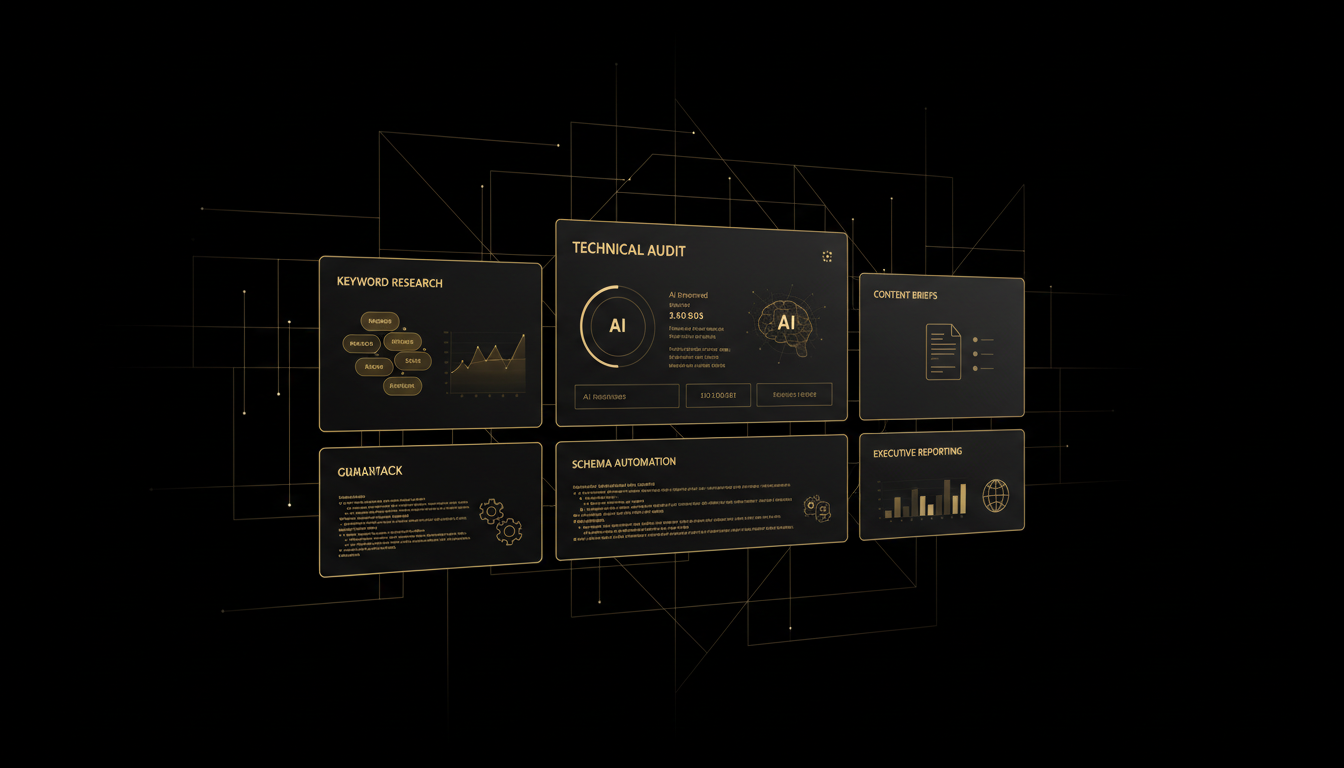
Choosing the best SEO software for agencies in 2026 is no longer just about keyword rankings. The search landscape now includes Google AI Overviews, generative engine optimization (GEO), and AI answer engines that pull structured, authoritative content from across the web. Agencies that rely on legacy point solutions — one tool for audits, another for content, a third for reporting — are losing ground to competitors who operate from a unified AI-powered platform. This guide breaks down what modern agency SEO software must do, how to evaluate your options, and why consolidation is the defining workflow decision of 2026.
Quick answer: The best SEO software for agencies in 2026 combines AI-powered technical audits, multi-client workspace management, keyword research with intent mapping, automated schema markup, GEO and AI Overview readiness checks, AI-generated content briefs, backlink analysis, and white-label executive reporting inside a single platform. All-in-one platforms like Black & Gold SEO eliminate the cost and friction of maintaining five or more separate subscriptions. Agencies that consolidate onto one platform reduce tool-switching time, close data silos between audit and content teams, and deliver faster, more consistent results across every client account.
Why Agency SEO Software Requirements Changed in 2026
The shift is structural, not incremental. Google's AI Overviews now appear on a significant share of commercial and informational queries, meaning a page can rank in position one and still receive fewer clicks if an AI-generated answer satisfies the user above the fold. At the same time, ChatGPT, Perplexity, and other AI answer engines are routing research queries away from traditional search entirely.
For agencies, this creates two parallel optimization tracks: classic organic search (rankings, CTR, technical health) and generative engine optimization (being cited, quoted, and surfaced by AI systems). Most legacy SEO tools were built for the first track only. The best agency platforms in 2026 handle both.
The Multi-Tool Problem Is Getting Expensive
A typical mid-size agency in 2025 ran at least four to six separate subscriptions: a crawler like Screaming Frog, a keyword and competitive intelligence suite like Semrush, a content optimization tool like Surfer SEO, a backlink monitor, a reporting layer, and something for schema. Combined annual costs frequently exceeded $10,000 per year before factoring in the staff time spent moving data between tools.
Beyond cost, the fragmentation creates real quality problems. Keyword insights don't automatically inform content briefs. Audit findings don't connect to schema recommendations. Executive reports require manual assembly from multiple exports. Each handoff is a place where context gets lost and errors get introduced.
See how Black & Gold SEO compares to Semrush for a direct breakdown of what consolidation actually saves.
What GEO and AI Overviews Demand From Your Toolset
Generative engine optimization requires your platform to do things traditional SEO tools were never designed for: identify whether content is structured for AI citation, flag missing entity context, automate schema markup that satisfies both Google's structured data requirements and AI retrieval systems, and surface content gaps that prevent AI systems from treating your client as an authoritative source.
The Google Search Central structured data guide makes clear that structured data remains one of the most direct signals an agency can control to influence how content appears in rich results and AI-enhanced search features. Agencies without schema automation are leaving that signal on the table for every client, every month.
What Matters Most: How to Evaluate Agency SEO Software
Before comparing platforms, define your evaluation criteria. The following framework applies whether you manage five clients or fifty.
| Evaluation Criterion | Why It Matters for Agencies |
|---|---|
| Multi-client workspace | Separate data, permissions, and reporting per client without separate logins |
| AI-powered technical audit | Crawl at scale, prioritize fixes by revenue impact, not just severity |
| Keyword research with intent mapping | Match keywords to funnel stage, not just search volume |
| Content brief generation | Reduce brief creation time from hours to minutes per page |
| Schema automation | Apply structured data across client sites without manual coding |
| GEO / AI Overview readiness | Surface optimization gaps for AI-driven search features |
| White-label executive reporting | Deliver board-ready reports without manual assembly |
| E-E-A-T signals | Identify and strengthen experience, expertise, authority, and trust signals |
| Pricing model | Per-client or per-crawl pricing that scales without punishing growth |
Agencies should weight multi-client management and reporting highest. A tool that excels at keyword research but requires manual report assembly will cost more in staff time than it saves in subscription fees.
Core Modules Every Agency SEO Platform Must Include
Technical SEO Audit at Scale
A technical audit module for agencies is not the same as a single-site crawler. It needs to handle simultaneous crawls across dozens of client domains, surface critical issues with clear prioritization, and connect audit findings to content and schema recommendations in the same workflow. The Google SEO Starter Guide outlines the foundational technical requirements that remain non-negotiable: crawlability, indexability, mobile usability, page experience signals, and structured data implementation.
Black & Gold SEO's audit module is built specifically for agency-scale crawling, with findings that feed directly into content and schema workflows rather than sitting in an isolated export.
AI-Generated Content Briefs and On-Page Optimization
Content brief creation is one of the highest-labor tasks in an agency workflow. A strong platform generates briefs that include target keyword, semantic entity coverage, recommended heading structure, E-E-A-T signals to include, and GEO-readiness guidance — all from a single input. This connects directly to the AI SEO workflow for agencies that separates high-output agencies from those still building briefs manually in Google Docs.
Schema Automation
Schema markup is no longer optional for agencies that want clients to appear in rich results and AI-generated answers. Manual schema implementation at agency scale is impractical. Automated schema generation — tied to page type, content context, and entity relationships — is the only way to maintain consistent structured data across a large client portfolio. For a deeper look at how schema automation works in practice, see the guide on AI schema automation for SEO and AI answer engines.
White-Label Executive Reporting
Reporting is where agencies win or lose client retention. Executives do not read raw data exports. They read narratives that connect SEO activity to business outcomes: traffic trends, lead attribution, visibility against competitors, and progress toward defined goals. The guide on how to build client-ready SEO reports executives actually read covers the structure in detail. The platform should automate the data assembly so strategists spend their time on interpretation, not formatting.
Is Consolidation Worth the Transition Cost?
The honest answer is: almost always yes, but the math depends on your current stack. Agencies running four or more separate tools typically find that an all-in-one platform reduces total software spend while also recovering 5–10 hours per week in staff time previously spent on data transfer and report assembly.
For a detailed cost-versus-ROI analysis, the AI SEO pricing guide for agencies walks through the calculation with realistic numbers across different agency sizes.
The transition risk is real but manageable. The key is choosing a platform that covers your highest-volume workflows first — typically auditing and reporting — and migrating content and keyword workflows in a second phase.
Frequently Asked Questions
What is the best SEO software for agencies managing multiple clients in 2026?
The best SEO software for agencies in 2026 combines AI-powered technical audits, automated multi-client reporting, keyword research, content briefs, and schema automation in one platform. All-in-one tools like Black & Gold SEO eliminate the need to stitch together five or more separate subscriptions, reducing cost and workflow friction.
What features should agency SEO software include?
Agency SEO software should include technical site auditing at scale, AI-generated content briefs, keyword research with intent mapping, backlink analysis, schema markup automation, GEO and AI Overview readiness checks, white-label executive reporting, and multi-client workspace management.
How much does SEO software for agencies cost in 2026?
Agency SEO platform pricing in 2026 ranges from roughly $99 to $500 or more per month depending on the number of clients, crawl limits, and AI feature depth. All-in-one platforms typically offer better ROI than assembling separate tools for audits, reporting, and content optimization.
Is AI-powered SEO software better for agencies than traditional tools?
Yes. AI-powered SEO software automates time-intensive tasks like technical audits, content gap analysis, schema generation, and reporting, allowing agencies to scale client work without proportionally increasing headcount. AI tools also surface GEO and AI Overview optimization opportunities that traditional tools miss.
Can one SEO platform replace multiple agency tools like Semrush, Screaming Frog, and Surfer?
Modern all-in-one SEO platforms are designed to consolidate auditing, keyword research, content optimization, backlink analysis, and reporting into a single workspace. This reduces subscription costs, eliminates data silos, and streamlines agency workflows compared to managing three to six separate tools.
The Practical Next Step
If you are currently running three or more separate SEO tools for your agency, the most useful thing you can do this week is map which workflows each tool owns and identify where data is being manually transferred between them. That map will show you exactly where consolidation saves the most time — and give you a clear baseline to measure against after switching.
Explore the full feature set at Black & Gold SEO's platform overview to see how the 19 AI-powered modules map to your current stack.