How to Choose the Right SEO Audit Tool: Features, Accuracy & ROI
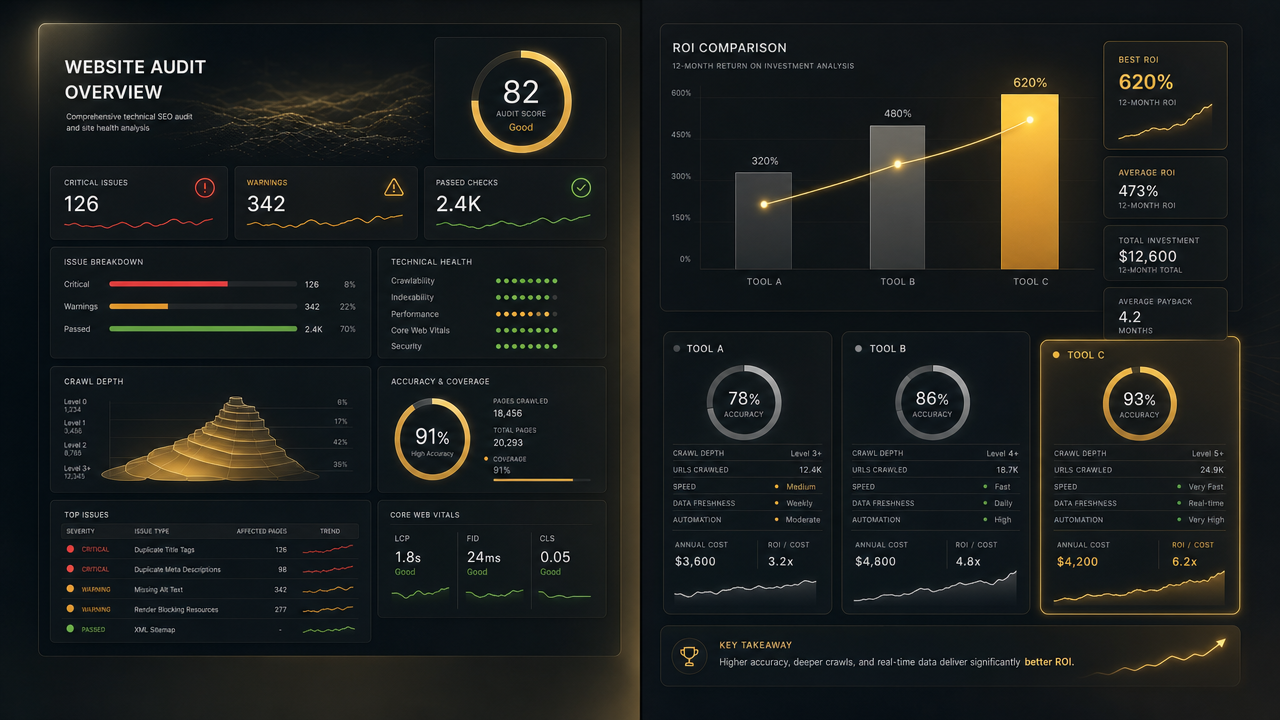
Choosing the right SEO audit tool is one of the highest-leverage decisions you can make for your organic search strategy. The wrong choice costs you time, surfaces false positives, and leaves critical technical issues buried. The right choice pays for itself within a single client engagement or campaign cycle.
Quick answer: The best SEO audit tool combines deep technical crawling, accurate on-page analysis, backlink auditing, Core Web Vitals reporting, and AI-driven prioritization. Look for low false-positive rates, JavaScript rendering support, and clear actionable output—not just a long list of warnings.
This guide walks through every dimension worth evaluating: feature depth, diagnostic accuracy, workflow fit, and measurable ROI. Whether you run a boutique agency or manage SEO in-house, the framework below applies.
Why the SEO Audit Tool You Pick Actually Matters
Most SEO practitioners have tried at least three or four tools and settled on a default out of habit rather than deliberate evaluation. That default choice often means paying for capabilities you don't use while missing the diagnostics you actually need.
A technical SEO audit is only as useful as the tool performing it. A crawler that misses JavaScript-rendered content will give you a clean bill of health on a site that Google can't properly index. An on-page analyzer that flags every missing H2 as critical will bury the genuinely damaging issues under noise. These aren't edge cases—they're common failure modes across popular tools.
The stakes are real: a missed crawl budget issue on a large e-commerce site can suppress thousands of product pages. An undetected Core Web Vitals regression can quietly erode rankings over weeks before anyone notices. The right tool surfaces these problems fast, in plain language, with enough context to act immediately.
Core Features to Evaluate in Any SEO Audit Tool
Technical Crawling Depth and Fidelity
The website crawler is the engine underneath every audit. Evaluate it on three dimensions:
Crawl depth and scale. Can it handle sites with hundreds of thousands of URLs without throttling or timing out? Does it respect robots.txt correctly while still giving you visibility into what's being blocked?
JavaScript rendering. A significant portion of modern websites rely on client-side rendering for navigation, content, and internal links. A crawler that doesn't render JavaScript will miss entire link graphs and content blocks. This is a non-negotiable capability for any serious technical SEO audit.
Crawl configuration. The best tools let you simulate Googlebot, set custom user agents, adjust crawl speed to avoid server load, and segment crawls by subdomain or subfolder. This flexibility matters when auditing large or complex site architectures.
On-Page SEO Analysis
On-page analysis should go beyond checking title tags and meta descriptions. Look for a tool that evaluates:
- Title tag uniqueness and character length
- Heading hierarchy and semantic structure
- Internal link distribution and anchor text patterns
- Canonical tag implementation and conflicts
- Structured data validity against current schema standards
- Content duplication at the page and site level
The output should distinguish between critical issues, warnings, and informational notices—and ideally weight them by estimated ranking impact rather than treating every flag equally.
Backlink Analysis and Link Profile Health
Backlink analysis within an audit context is about identifying toxic or manipulative links, monitoring anchor text distribution, and flagging sudden changes in link velocity that might indicate negative SEO. A strong SEO audit tool either includes its own link index or integrates cleanly with established backlink databases.
Pay attention to how the tool handles disavow workflows. The ability to export a clean disavow file directly from the audit interface saves meaningful time during link cleanup projects.
Core Web Vitals and Page Experience Signals
Google's page experience signals—particularly Core Web Vitals metrics like Largest Contentful Paint, Cumulative Layout Shift, and Interaction to Next Paint—are now established ranking factors. Any audit tool worth using in the current environment must surface these metrics at scale, not just for a single URL.
The most useful implementations pull field data from the Chrome User Experience Report alongside lab data, giving you both real-world performance and a reproducible test baseline. Look for tools that flag CWV regressions proactively rather than waiting for you to run a manual check.
Accuracy: The Dimension Most Buyers Overlook
Feature lists are easy to compare. Accuracy is harder to evaluate but more consequential.
How to Test Tool Accuracy Before Committing
The most reliable method is to audit a site you know intimately—one where you've already done manual analysis or resolved known issues. Run the tool against it and compare:
- Does it catch the issues you already know exist?
- Does it surface false positives that would waste your team's time?
- Does it miss anything significant?
Pay particular attention to how the tool handles edge cases: hreflang implementation on multilingual sites, pagination signals, faceted navigation, and dynamic parameter handling. These are the areas where lower-quality tools diverge most sharply from reality.
AI-Driven Prioritization and Noise Reduction
Modern AI SEO platforms add a meaningful layer on top of raw crawl data by prioritizing issues based on estimated impact. Rather than presenting 847 warnings in alphabetical order, an AI-assisted audit surfaces the five issues most likely to move rankings if fixed today.
This prioritization is only valuable if the underlying model is calibrated against real search performance data. Ask vendors how their prioritization logic works and whether it accounts for site size, industry, and current ranking position.
Evaluating ROI: What the Numbers Should Tell You
Time Savings as a Measurable Outcome
The most direct ROI calculation for an SEO audit tool is hours saved per audit. A manual technical audit of a mid-size site typically takes a skilled practitioner eight to twenty hours. A well-configured automated audit compresses that to two to four hours of review and prioritization time.
For agencies, that delta translates directly to margin. For in-house teams, it translates to capacity—the ability to audit more frequently, catch regressions faster, and spend analyst time on strategy rather than data collection.
Ranking and Traffic Impact as a Downstream Metric
The longer-term ROI case rests on the quality of fixes the tool enables. An audit that surfaces a crawlability issue affecting 30% of a site's indexed pages, or a Core Web Vitals problem suppressing click-through rates, can drive measurable organic traffic recovery within weeks of remediation.
Track this by connecting your audit tool's issue log to your rank tracking data. When you resolve a flagged issue, note the date and monitor ranking movement for the affected pages over the following four to eight weeks. Over time, this creates an empirical record of which issue types deliver the highest ranking return—and which are noise.
Explore the features available on the Black & Gold SEO platform to see how technical auditing, rank tracking, and AI prioritization work together in a single workflow. If you're evaluating pricing relative to agency use cases, the pricing page breaks down tiers by crawl volume and reporting needs.
Matching Tool Capabilities to Your Use Case
Not every team needs the same tool. A freelance consultant auditing five sites per month has different requirements than an agency running weekly automated audits across a hundred client domains.
Freelancers and small agencies should prioritize ease of use, clean reporting output for clients, and a meaningful free tier or low entry price. The ability to white-label reports is often worth paying for at this scale.
Mid-size agencies need crawl volume, multi-user access, and integrations with project management and reporting tools. Automated scheduling and change detection—alerts when a site's technical health score drops between crawls—become essential at this scale.
Enterprise in-house teams require log file analysis, custom extraction capabilities, API access for integration with internal dashboards, and the ability to segment audits by site section or template type.
If you're ready to test how a modern AI SEO platform handles your specific site, start a free audit at Black & Gold SEO—no credit card required.
For a broader look at how audit capabilities fit into a full-service SEO workflow, the services overview covers how technical auditing connects to content strategy, backlink outreach, and GEO optimization.
Frequently Asked Questions
What should I look for in an SEO audit tool? Look for a tool that offers deep technical crawling, accurate on-page analysis, backlink auditing, Core Web Vitals reporting, and clear actionable recommendations. Bonus points if it integrates AI to prioritize fixes by impact and supports automated reporting for clients or stakeholders.
How accurate are SEO audit tools? Accuracy varies significantly between tools. The best SEO audit tools cross-reference crawl data with real search engine signals, validate structured data against current schema standards, and flag issues with low false-positive rates. Always test a tool against a site you know well before committing.
Are free SEO audit tools worth using? Free SEO audit tools are useful for quick surface-level checks but typically cap crawl depth, limit reporting features, and lack advanced diagnostics like JavaScript rendering or log file analysis. For serious agency or business use, a paid or freemium tool with a meaningful free tier delivers far better ROI.
What is the ROI of using an SEO audit tool? ROI from an SEO audit tool comes from faster issue discovery, reduced manual auditing hours, and higher-quality fixes that improve rankings and organic traffic. Agencies typically recover the tool cost within the first client engagement when the tool surfaces high-impact technical issues that would otherwise take days to find manually.
How is an SEO audit tool different from a rank tracker? An SEO audit tool analyzes your website's technical health, on-page optimization, and link profile to identify problems. A rank tracker monitors where your pages appear in search results over time. Many modern all-in-one SEO platforms combine both functions, giving you a complete picture of performance and issues in one place.
The Practical Next Step
Before committing to any SEO audit tool, run it against a live site you manage and compare its output against what you already know. Look for the ratio of genuine issues to noise, check whether it renders JavaScript correctly, and verify that Core Web Vitals data reflects real user experience rather than just lab scores.
If your current tool is producing long issue lists without clear prioritization, or if you're spending more time filtering audit output than acting on it, that's the signal to evaluate alternatives. Create a free account at Black & Gold SEO and run your first AI-powered audit today—the output will give you an immediate benchmark for comparison.
About the Author
Written by Chris Taylor for blackandgoldseo.com. Chris Taylor is co-owner of Taylor Family Store LLC, a faith-based full-service estate company established in 2023. He is the founder of Taylor Family Software and president of Tools for Teens, a nonprofit helping teens and young adults turn their passions into the skills and credentials they need for meaningful employment and entrepreneurship. Chris has been selling on eBay for over twenty years.
← All posts