How to Track Keyword Rankings Accurately: Tools, Metrics & Reporting
If you want to grow organic traffic with intention rather than guesswork, you need to track keyword rankings with the same discipline you apply to any other business metric. Ranking position is not a vanity number — it is a leading indicator of visibility, click-through rate, and ultimately revenue. This guide covers everything from choosing the right tools to building reports that actually drive decisions.
Quick answer: Tracking keyword rankings means monitoring where your web pages appear in search engine results pages (SERPs) for specific search terms over time, using a dedicated tool that checks positions from neutral, non-personalized IP addresses. Accurate tracking separates desktop from mobile results, targets your precise geographic market, and pairs position data with organic traffic metrics from Google Search Console to give you a complete picture of SEO performance.
Why Keyword Rank Tracking Is a Core SEO Discipline
Organic search visibility is not static. Google updates its algorithm hundreds of times per year, competitors publish new content daily, and SERP features like featured snippets, local packs, and People Also Ask boxes constantly reshape which positions actually drive clicks. Without systematic rank tracking, you are navigating blind.
The practical value of monitoring SERP positions goes beyond knowing whether you are on page one or page two. It tells you:
- Whether a recent content update or technical fix moved the needle
- Which pages are losing ground before the traffic drop becomes visible in analytics
- Where you are close enough to the top three to justify a focused optimization push
- How your visibility compares to competitors targeting the same terms
For agencies managing multiple clients, rank tracking is also the foundation of credible SEO reporting — the evidence that connects your work to measurable outcomes.
The Difference Between Rank Tracking and Traffic Reporting
A common mistake is treating keyword rankings and organic traffic as interchangeable metrics. They are related but distinct. Rankings tell you where you appear; traffic tells you how many people actually clicked. A page can rank number two for a high-volume keyword and still receive modest traffic if a featured snippet or ad block dominates the SERP. Conversely, a page ranking sixth for a low-competition, high-intent keyword can drive significant conversions.
The most useful SEO reporting combines both: rank position from a dedicated tracking tool and impressions, clicks, and average position data from Google Search Console. Together they reveal whether your rankings are translating into the traffic and engagement your business needs.
Personalization and Why Manual Checks Fail
If you search for your own keywords in your browser to check rankings, you are not seeing what your customers see. Google personalizes results based on your search history, location, device, and logged-in account. A keyword you rank fourth for nationally might appear first in your browser simply because you have visited your own site repeatedly. Dedicated rank tracking tools check positions from neutral IP addresses in your specified location and device type, which is the only way to get an accurate, reproducible baseline.
Choosing the Right Rank Tracking Tools
The market for rank tracking tools ranges from standalone trackers to full SEO platforms that bundle rank monitoring with site audits, backlink analysis, and content intelligence. The right choice depends on the scale of your campaigns, how granular your location targeting needs to be, and whether you need white-label reporting for clients.
Key Features to Evaluate
Tracking frequency. Daily tracking is the gold standard for competitive keywords or active campaigns. Weekly tracking is sufficient for most informational content. Avoid tools that only update monthly — too much can change in 30 days.
Location and device granularity. For national campaigns, country-level tracking is a starting point. For local SEO, you need city, zip-code, or even GPS-coordinate-level tracking to reflect how results actually vary across a metro area. Separate desktop and mobile tracking is non-negotiable because mobile SERPs frequently differ from desktop results, and mobile-first indexing means Google primarily uses the mobile version of your site for ranking.
SERP feature detection. Modern SERPs are rich with features — featured snippets, image packs, local packs, video carousels, and more. A good rank tracking tool flags when you own or lose one of these features, because a featured snippet at position zero can double your click-through rate compared to a standard first-place result.
Google Search Console integration. Pairing your rank tracker with GSC data gives you impressions and click data alongside position, which is essential for calculating true organic visibility and identifying keywords where you rank but receive few clicks.
Reporting and export. If you report to clients or stakeholders, look for tools that generate clean, branded reports on a schedule — PDF exports, live dashboards, or white-label portals. Manual reporting is a time sink that does not scale.
The Black & Gold SEO platform features include rank tracking alongside technical audits, backlink monitoring, and AI-driven content tools, which means you can manage the full SEO workflow without stitching together multiple subscriptions.
Local SEO Rank Tracking: A Separate Discipline
Local keyword rankings deserve their own section because they behave differently from standard organic results. A business ranking well in one neighborhood may not appear at all in a search conducted five miles away. Google's local algorithm factors in proximity, relevance, and prominence, and the results in Google Maps or the Local Pack are ranked separately from the standard blue-link organic results below them.
How to Set Up Local Rank Tracking Accurately
When configuring local rank tracking, define your target location as precisely as your business requires. A single-location restaurant should track rankings at the neighborhood or zip-code level. A regional service business with multiple locations should set up separate tracking campaigns per location, using each location's address as the geographic anchor.
Track your rankings in both the standard organic results and the Local Pack separately. Appearing in the Local Pack for "plumber near me" is a fundamentally different visibility win than ranking organically for "best plumber in [city]" — both matter, but they require different optimization strategies and should be reported distinctly.
For businesses with multiple locations, the Black & Gold SEO services include local SEO rank tracking configured per location, which removes the manual overhead of managing separate campaigns for each branch or franchise.
Tracking Cadence for Local Campaigns
Local SERPs can shift quickly, especially after a competitor earns new reviews, updates their Google Business Profile, or gains local citations. Weekly tracking per location is the minimum recommended cadence. For highly competitive local markets — legal, medical, home services — daily tracking lets you respond to drops before they affect lead volume.
Building a Keyword Ranking Report That Drives Decisions
A ranking report that only lists positions is a missed opportunity. The goal of SEO reporting is to connect ranking data to business outcomes and surface the next action. Here is a structure that works for both internal teams and client-facing reports.
Executive summary. One paragraph covering overall visibility trend, notable wins (new first-page rankings, featured snippet gains), and any significant drops requiring attention.
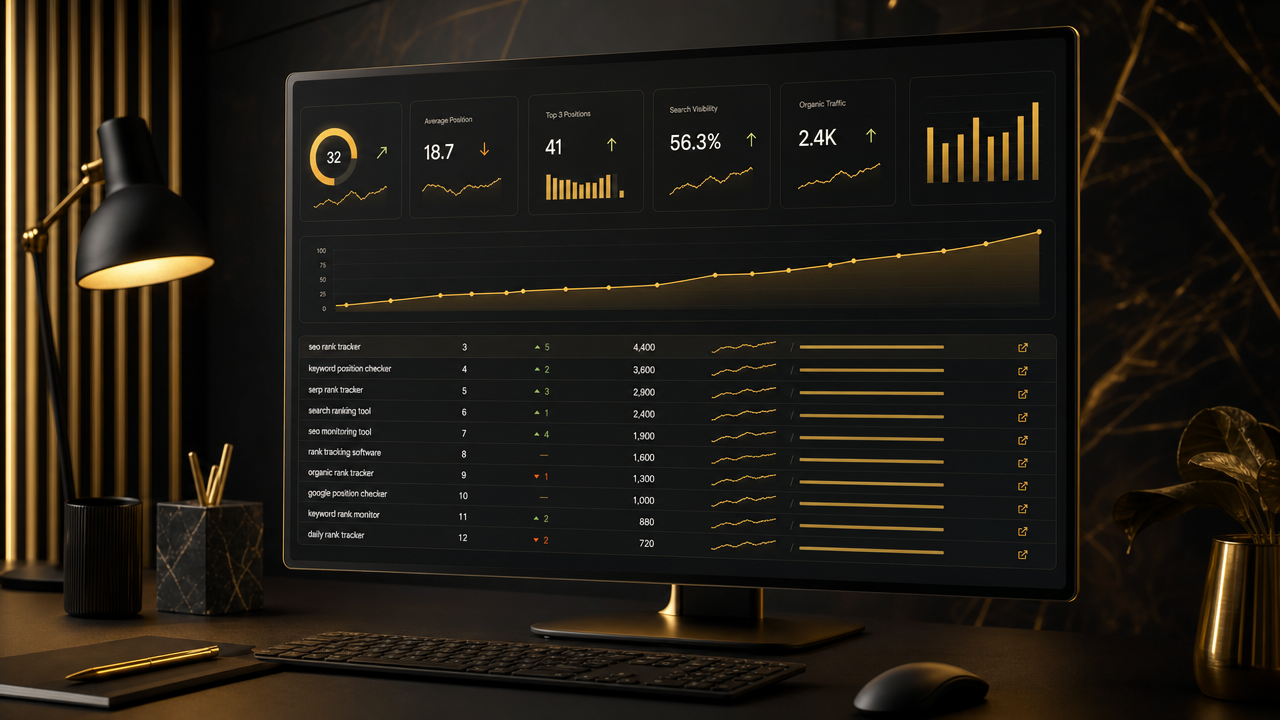
Rank movement table. Current position, previous position, change, search volume, and estimated CTR at that position for each tracked keyword. Group by topic cluster or page rather than listing keywords alphabetically.
Organic traffic correlation. Pull impressions and clicks from Google Search Console for the same period. If rankings improved but clicks did not, investigate SERP feature changes or title tag optimization opportunities.
Visibility score. Express your overall organic visibility as a percentage of total possible clicks for your tracked keyword set. This single number makes it easy to communicate progress over time without requiring stakeholders to interpret dozens of individual rank positions.
Opportunities and next actions. Identify keywords ranking in positions four through fifteen — these are your highest-leverage targets for incremental optimization. A page moving from position eight to position three can multiply its traffic several times over with focused on-page work.
You can explore pricing options for rank tracking and full-platform access, or create a free account to run an initial audit and see where your current keyword positions stand before building out a tracking campaign.
FAQ: Tracking Keyword Rankings
What is keyword rank tracking and why does it matter for SEO? Keyword rank tracking is the process of monitoring where your web pages appear in search engine results pages (SERPs) for specific search terms over time. It matters because your ranking position directly influences how much organic traffic you receive — the top three results capture the majority of clicks. Tracking rankings lets you measure the impact of your SEO efforts, spot drops before they hurt traffic, and identify opportunities to move from page two to page one.
How often should I check my keyword rankings? For most websites, checking keyword rankings weekly is the right cadence — it gives you enough data to spot meaningful trends without overreacting to daily SERP fluctuations. High-traffic or highly competitive keywords may warrant daily monitoring, especially after publishing new content or making on-page changes. For local SEO campaigns, checking rankings at least weekly per location is recommended since local SERPs can shift quickly.
What is the most accurate way to track keyword rankings? The most accurate way to track keyword rankings is to use a dedicated rank tracking tool that checks positions from neutral, non-personalized IP addresses in your target location and device type. Avoid checking rankings manually in your own browser because Google personalizes results based on your search history and location. Tools that track rankings at the city or zip-code level, separate desktop from mobile results, and pull data daily give you the most reliable picture of your true SERP position.
Which metrics should I include in a keyword ranking report? A strong keyword ranking report should include: current rank position and rank change over the reporting period, search volume for each tracked keyword, estimated organic click-through rate at that position, organic impressions and clicks from Google Search Console, visibility score, and any featured snippet or SERP feature wins. Pairing position data with traffic and conversion metrics tells a complete story beyond just rank numbers.
Can I track keyword rankings for local SEO? Yes, and local rank tracking is essential for businesses targeting customers in specific cities, regions, or neighborhoods. Local keyword rankings can vary significantly even a few miles apart because Google tailors results based on the searcher's location. A good local SEO rank tracking tool lets you set a precise geographic target — down to zip code or GPS coordinates — and track rankings separately for Google Maps or the Local Pack versus standard organic results.
Your Next Step
The most practical thing you can do today is establish a baseline. Before you optimize a single page or build a single link, you need to know where you currently stand. Start a free SEO audit at Black & Gold SEO to surface your current keyword positions, identify technical issues affecting your rankings, and build the foundation for a tracking campaign that turns data into consistent organic growth.
About the Author
Written by Chris Taylor for blackandgoldseo.com. Chris Taylor is co-owner of Taylor Family Store LLC, a faith-based full-service estate company established in 2023. He is the founder of Taylor Family Software and president of Tools for Teens, a nonprofit helping teens and young adults turn their passions into the skills and credentials they need for meaningful employment and entrepreneurship. Chris has been selling on eBay for over twenty years.
← All posts