Best SEO Audit Tools in 2026: Compared for Agencies
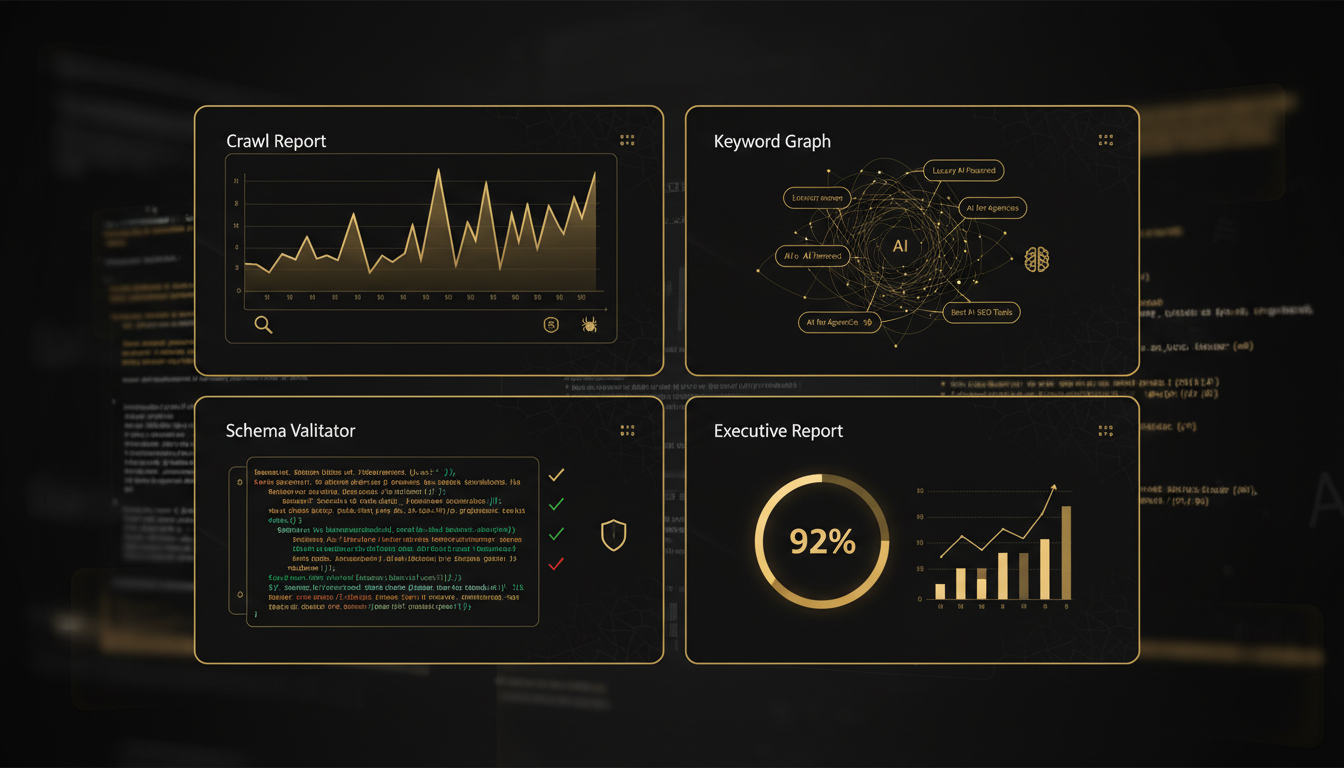
If you're evaluating the best SEO audit tools for agencies heading into 2026, the landscape looks meaningfully different from even two years ago. AI-powered platforms have moved from novelty to necessity, generative engine optimization (GEO) has become a real ranking consideration, and the old workflow of stitching together Screaming Frog, Semrush, and Ahrefs is starting to show its seams — in both cost and efficiency.
Quick answer: The best SEO audit tools for agencies in 2026 are those that combine automated technical crawling, AI-driven issue prioritization, schema markup validation, keyword research, backlink analysis, and executive-ready reporting inside a single platform. Screaming Frog remains the gold standard for raw crawl depth. Semrush and Ahrefs lead in competitive intelligence. But all-in-one AI platforms like Black & Gold SEO close the gap by integrating every audit layer — including GEO and AI search readiness checks — without requiring agencies to manually sync data across three or four separate subscriptions. For agencies managing multiple clients, the consolidated workflow is often the deciding factor.
What Agencies Actually Need From an SEO Audit Tool
Before comparing specific platforms, it helps to define what "agency-grade" means in practice. A solo consultant running five clients has different requirements than a 20-person agency managing 80 accounts. That said, certain capabilities are non-negotiable at any scale.
What Matters Most: Our Evaluation Framework
We evaluated each tool against the following criteria, weighted toward agency workflows:
- Technical crawl depth — Can it find Core Web Vitals issues, crawl budget waste, redirect chains, and hreflang errors at scale?
- AI-powered prioritization — Does it rank issues by estimated ranking impact, or just dump a raw error list?
- On-page and content optimization — Does it go beyond meta tags to evaluate entity coverage, topical authority, and E-E-A-T signals?
- Schema markup automation — Can it validate and generate structured data without manual JSON-LD editing?
- GEO and AI search readiness — Does it account for how generative AI systems retrieve and cite content?
- Multi-client project management — Can you manage separate client workspaces cleanly?
- Reporting quality — Are reports white-label, executive-readable, and exportable without heavy manual formatting?
- Cost-per-feature value — What does the all-in cost look like when you factor in what you'd otherwise pay for separate tools?
Head-to-Head: Top SEO Audit Tools Compared
| Tool | Technical Crawl | AI Prioritization | Schema Automation | GEO Readiness | White-Label Reporting | Starting Price |
|---|---|---|---|---|---|---|
| Black & Gold SEO | Yes | Yes | Yes (automated) | Yes | Yes | Competitive |
| Screaming Frog | Deep | No | Limited | No | No | ~$259/yr |
| Semrush | Moderate | Partial | Limited | Partial | Yes (paid tiers) | ~$140/mo |
| Ahrefs | Moderate | No | No | No | Limited | ~$129/mo |
This table reflects general platform capabilities based on publicly documented features. Pricing is approximate and subject to change; always verify current plans directly with each vendor.
Screaming Frog: Still the Crawl Benchmark
Screaming Frog SEO Spider remains the most respected dedicated crawl tool in the industry, and for good reason. Its ability to surface broken links, duplicate content, redirect chains, missing canonical tags, and JavaScript rendering issues at scale is unmatched among desktop crawlers.
Where It Falls Short for Agencies
The limitations become apparent when you move beyond raw crawl data. Screaming Frog produces no AI-driven prioritization — you receive a spreadsheet of issues and must interpret them yourself. There is no built-in keyword research, no backlink data, no content optimization layer, and no executive reporting. For agencies, that means Screaming Frog is always a component of a larger toolstack, not a standalone solution.
If you want to understand how to layer a crawl tool into a broader audit workflow, how to use AI for technical SEO audits walks through the integration logic in detail.
Semrush and Ahrefs: Competitive Intelligence Leaders With Audit Gaps
Both Semrush and Ahrefs built their reputations on keyword research and backlink analysis, and both have added site audit modules over time. Semrush's Site Audit tool is genuinely useful for catching on-page issues and monitoring crawl health across multiple projects. Ahrefs' Site Audit covers similar ground with a clean interface.
The Gaps That Matter for Agency Workflows
Neither platform offers meaningful schema markup automation. Neither provides a structured GEO or AI search readiness audit — a growing gap as Google AI Overviews and other generative retrieval systems influence click-through behavior. Reporting in both platforms is functional but rarely executive-ready without significant manual customization.
The cost picture also deserves scrutiny. An agency running Screaming Frog plus Semrush plus Ahrefs is looking at $400–$600 per month before adding any reporting or content optimization tools. For a detailed breakdown of how Black & Gold SEO compares to Semrush specifically on agency value, see the full Semrush comparison.
What Makes an AI-Powered SEO Platform Different?
The term "AI-powered" is overused in marketing copy, so it's worth being specific about what genuine AI integration looks like in an SEO audit context.
A traditional crawl tool identifies errors: missing H1 tags, slow page load times, broken internal links. An AI-powered SEO audit interprets those errors in context — weighting them by page authority, competitive landscape, and estimated ranking impact. It also evaluates dimensions that a crawler cannot: content quality relative to search intent, entity coverage gaps, schema completeness against Google's structured data requirements, and signals that generative AI systems use when deciding whether to cite a page.
The Google SEO Starter Guide establishes the foundational technical requirements every audit should cover. The Google Search Central structured data guide defines what valid schema implementation looks like. An AI-powered platform should automate compliance with both — not just flag violations.
For agencies, this matters because it changes the deliverable. Instead of handing a client a spreadsheet of 400 crawl errors, you deliver a prioritized action plan with business context. That shift in output quality is what building client-ready SEO reports executives actually read is built around.
Schema Automation as a Competitive Differentiator
Schema markup is one of the highest-leverage technical SEO activities for agencies, and one of the most consistently under-delivered. Manual JSON-LD editing is slow, error-prone, and difficult to scale across dozens of client sites. Automated schema generation — where the platform reads page content and generates appropriate structured data — removes that bottleneck entirely.
This is particularly important for GEO. AI answer engines rely heavily on structured data to understand entity relationships, page type, and content authority. AI schema automation for SEO, content, and AI answer engines covers the mechanics in depth.
Generative Engine Optimization: The Audit Layer Most Tools Are Missing
GEO — optimizing content so that generative AI systems retrieve and cite it — is not a future consideration. Google AI Overviews, Bing Copilot, and other AI-driven interfaces are already influencing organic traffic patterns. An SEO audit tool that ignores GEO signals is auditing for a search landscape that no longer fully exists.
What a GEO audit looks for includes: entity clarity and disambiguation, concise quotable passages, FAQ and structured content formats, schema coverage, and E-E-A-T signals that AI systems use as quality proxies. Most traditional crawl tools and even established platforms like Semrush and Ahrefs have limited native GEO audit capability.
Choosing the Right Tool for Your Agency
If you're still deciding which direction to go, how to choose an SEO audit tool provides a structured decision framework based on team size, client volume, and technical requirements.
The short version: agencies managing more than ten active clients, delivering regular reporting, and competing on technical SEO quality will find the most leverage in an all-in-one AI platform. Agencies with highly technical teams doing deep one-off audits may still want Screaming Frog in their toolkit. The two approaches are not mutually exclusive, but the trend is clearly toward consolidation.
Frequently Asked Questions
What is the best SEO audit tool for agencies in 2026?
The best SEO audit tool for agencies in 2026 depends on your workflow, but all-in-one AI platforms that combine technical crawling, on-page optimization, schema automation, and executive reporting in a single dashboard — like Black & Gold SEO — offer the strongest value compared to stitching together Screaming Frog, Semrush, and Ahrefs separately.
What features should an SEO audit tool have for agency use?
An agency-grade SEO audit tool should include automated technical crawling, AI-powered issue prioritization, multi-client project management, white-label reporting, schema markup validation, keyword research, backlink analysis, and GEO or AI search readiness checks.
How is an AI-powered SEO audit different from a traditional crawl?
An AI-powered SEO audit goes beyond crawling URLs for broken links or missing tags. It interprets content quality, entity coverage, schema completeness, and generative engine optimization signals — then prioritizes fixes by estimated ranking impact rather than listing raw errors.
Can one SEO audit tool replace Screaming Frog and Semrush for agencies?
Yes, modern all-in-one platforms can replace the need for separate crawl tools and keyword research suites. Platforms that include technical auditing, content optimization, backlink tracking, and reporting in one interface reduce tool costs and eliminate the manual work of syncing data across multiple apps.
How much do SEO audit tools cost for agencies in 2026?
Agency SEO audit tool pricing in 2026 ranges from around $99 per month for entry-level platforms to $500 or more per month for enterprise suites. All-in-one AI platforms typically offer better cost-per-feature value than subscribing to three or four specialized tools separately.
Sources and Further Reading
Next step: If you're ready to see how an all-in-one AI SEO platform performs against your current toolstack, explore the Black & Gold SEO features overview to walk through all 19 audit and optimization modules — or run a test audit on one of your active client sites to benchmark the output against what you're producing today.
← All posts