How to Rank in Google AI Overviews: A 2026 Step-by-Step Guide
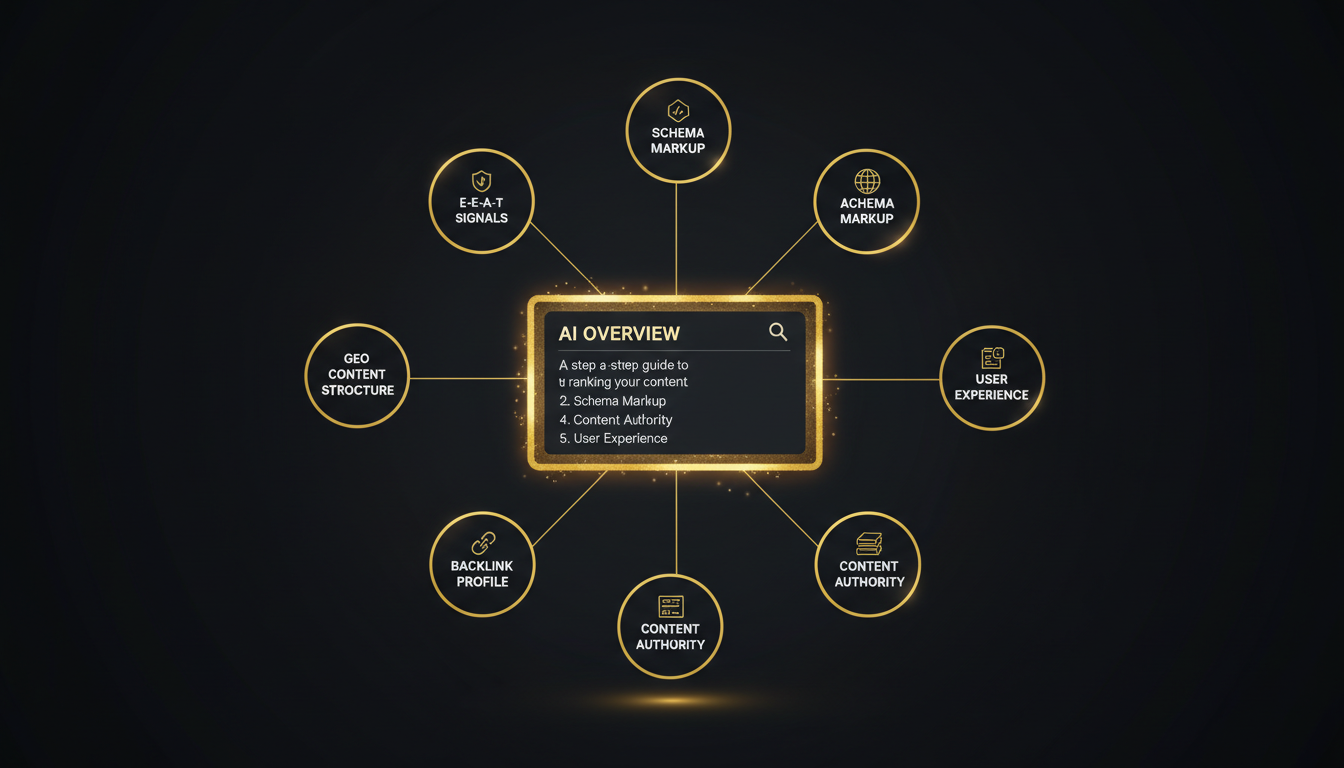
If you want to know how to rank in Google AI Overviews, the short answer is this: you need content that Google's generative model can confidently cite — meaning it must be accurate, authoritative, clearly structured, and directly answer the questions users are asking. This guide walks through every lever you can pull in 2026 to earn that citation, from foundational E-E-A-T signals to schema automation and Generative Engine Optimization (GEO) content structure.
Quick answer: To rank in Google AI Overviews, your content must satisfy five conditions simultaneously: strong E-E-A-T signals (experience, expertise, authoritativeness, trustworthiness), sufficient topical authority on the subject, a clear question-and-answer content structure that AI systems can parse at the passage level, relevant structured data such as FAQPage or HowTo schema, and credible trust signals including authoritative backlinks and verifiable factual claims. Pages that meet all five conditions give Google's large language model (LLM) the confidence to surface and cite specific passages inside an AI Overview panel. No single factor is sufficient on its own.
Why Google AI Overviews Changed the SEO Game
Google AI Overviews — the AI-generated answer panels that appear above traditional organic results — are powered by large language models trained to synthesize information from multiple sources. They evolved from the Search Generative Experience (SGE) that Google tested in 2023, and by 2026 they appear for a significant share of informational and transactional queries.
The implication for SEO is structural: Google is no longer just ranking pages, it is selecting passages from pages to build a synthesized answer. That means the unit of competition has shifted from the full page to the individual paragraph or sentence. A page can rank on page one organically and still never appear in an AI Overview. Conversely, a page that sits at position four or five can earn an AI Overview citation if its content is more clearly structured and more directly quotable.
This is the core insight behind Generative Engine Optimization (GEO) — a discipline that treats AI retrieval as a distinct optimization target alongside traditional organic ranking.
What Matters Most: The AI Overview Citation Framework
Before diving into tactics, here is the decision framework that determines whether a page earns an AI Overview citation. Use this as your optimization checklist.
| Signal Category | What Google's AI Evaluates | Priority |
|---|---|---|
| E-E-A-T | Experience, expertise, authority, trust at page and domain level | Critical |
| Topical Authority | Depth and breadth of coverage on the subject cluster | Critical |
| Content Structure | Question-answer format, passage-level clarity, concise definitions | High |
| Structured Data | FAQPage, HowTo, Article, and entity schema | High |
| Trust Signals | Backlinks, citations, factual accuracy, source transparency | High |
| Technical Accessibility | Crawlability, page speed, mobile rendering | Baseline |
Step 1: Build Genuine E-E-A-T Before Optimizing for AI
E-E-A-T — Experience, Expertise, Authoritativeness, and Trustworthiness — is not a checklist item you add at the end. It is the foundation that determines whether Google's model trusts your content enough to cite it at all.
What E-E-A-T Looks Like in Practice
Experience means demonstrating firsthand knowledge: case studies, original data, real examples from your work. Expertise means the content is written or reviewed by someone with verifiable credentials in the subject. Authoritativeness means your domain and individual pages earn recognition from other credible sources — primarily through backlinks and mentions. Trustworthiness means your claims are accurate, your sources are real, and your site is technically secure and transparent.
The Google helpful content guidance makes clear that content should be written for people first, not for search engines. That principle applies with even greater force to AI Overviews, because the model is explicitly selecting content it can present as a reliable answer to a user.
Practical actions: audit your existing content for unsupported claims, add author context at the page level, earn backlinks from topically relevant and authoritative domains, and ensure every factual claim can be traced to a verifiable source.
Step 2: Establish Topical Authority Across Your Subject Cluster
Google's AI systems do not evaluate pages in isolation. They evaluate how comprehensively a domain covers a topic. Topical authority — the degree to which your site is recognized as a definitive resource on a subject — is one of the strongest predictors of AI Overview citation frequency.
How to Build Topical Authority Systematically
Start with a content cluster map. Identify the core topic (for example, "Google AI Overviews") and map every related subtopic, question, and entity that a comprehensive resource would cover. Then audit your existing content against that map to find gaps.
For each gap, create content that answers the specific question with depth and accuracy — not thin coverage designed to capture a keyword. Internal linking between cluster pages signals to Google that your site treats the topic as a coherent body of knowledge rather than a collection of isolated articles.
Our complete guide to getting cited in Google AI Overviews covers the content cluster approach in more detail, including how to prioritize which gaps to fill first based on AI Overview trigger frequency.
Step 3: Structure Content for Passage-Level Retrieval
Because AI Overviews select passages rather than pages, your content structure must make individual paragraphs independently useful and quotable.
The GEO Content Structure Formula
- Lead with a direct answer. The first paragraph of any section should answer the question that section addresses. Do not bury the answer after three sentences of context.
- Use question-based headings. H2 and H3 headings phrased as questions match the natural language queries that trigger AI Overviews and make it easier for the model to map your content to a user's question.
- Write concise definitions. For any entity or concept you cover, include a one-to-two sentence definition that stands alone. These are the passages most frequently surfaced in AI Overview citations.
- Avoid padding. Every sentence should add information. Transitional filler ("In this section, we will explore...") reduces the signal density of your content and makes it harder for the model to extract a clean answer.
The Google SEO Starter Guide reinforces the value of clear, well-organized content — advice that has become more consequential, not less, as AI retrieval layers on top of traditional ranking.
Step 4: Implement Structured Data That AI Systems Can Parse
Structured data is one of the clearest signals you can send to Google's AI systems about what your content means and how it should be interpreted. The Google Search Central structured data guide outlines the schema types Google officially supports.
Which Schema Types Matter Most for AI Overviews
- FAQPage schema marks up question-and-answer pairs, making them directly parseable by the model.
- HowTo schema signals step-by-step instructional content, which frequently triggers AI Overview panels for process-oriented queries.
- Article schema with author, datePublished, and organization markup reinforces E-E-A-T signals at the structured data level.
- Entity markup (using schema.org types for people, organizations, products, and concepts) helps the model understand the entities your content covers and their relationships.
Manual schema implementation at scale is impractical for agencies managing multiple clients. AI schema automation tools can generate and deploy the correct schema types based on content analysis, reducing implementation time while improving accuracy.
Step 5: Earn Trust Signals That Generative Models Recognize
Google's guidance on generative AI content is explicit: the quality and trustworthiness of content matters regardless of how it was produced. For AI Overviews specifically, trust signals include:
- Authoritative backlinks from domains that Google already trusts as sources in your topic area
- Accurate, verifiable factual claims — the model is less likely to cite content that contains claims inconsistent with its training data
- Source transparency — citing your own sources within the content signals that your claims are grounded
- Consistent entity context — using the correct names, definitions, and relationships for entities covered in your content helps the model map your content to its knowledge graph
How to Monitor AI Overview Citation Performance
Ranking in AI Overviews requires ongoing measurement, not a one-time optimization. Track:
- Whether your pages are being cited in AI Overview panels for target queries (manual spot-checks and third-party AI visibility tools)
- Impressions and click-through rate changes in Google Search Console for queries where AI Overviews are active
- Content gap closure rate — how many cluster topics you have covered versus the full map
- Schema validation status via Google's Rich Results Test
Use the AI Overviews step-by-step guide to build a repeatable audit and optimization workflow you can apply across multiple clients or content properties.
Frequently Asked Questions
What does it take to appear in Google AI Overviews?
To appear in Google AI Overviews, your content must demonstrate strong E-E-A-T signals, cover a topic with sufficient depth and topical authority, use clear question-and-answer structure, implement relevant schema markup, and earn enough trust signals — such as authoritative backlinks and accurate factual claims — for Google's generative model to confidently cite your page.
Does structured data help you rank in Google AI Overviews?
Yes. Structured data such as FAQPage, Article, and HowTo schema helps Google's AI systems parse your content's meaning and context more precisely, increasing the likelihood that specific passages are surfaced in AI Overview citations. Schema alone is not sufficient, but it is a meaningful supporting signal.
How is ranking in AI Overviews different from ranking in traditional organic search?
Traditional organic ranking rewards pages that match keyword intent and earn backlinks. AI Overview selection additionally rewards passage-level clarity, factual accuracy, entity context, and content that directly answers a question in a quotable, concise format — making GEO content structure and E-E-A-T signals especially important.
How long does it take to get cited in Google AI Overviews after optimizing content?
There is no fixed timeline. Pages with strong existing authority and clear GEO-optimized content can see AI Overview citations within days of re-indexing. For newer or lower-authority pages, building topical authority and earning backlinks typically takes weeks to months before consistent citation appears.
Can agencies use AI tools to optimize client content for Google AI Overviews at scale?
Yes. AI-powered SEO platforms can automate schema generation, identify content gaps relative to AI Overview triggers, produce structured content briefs aligned with GEO best practices, and monitor citation visibility across multiple clients — making it practical for agencies to apply AI Overview optimization at scale without proportional manual effort.
Sources and Further Reading
- Google helpful content guidance
- Google Search Central structured data guide
- Google SEO Starter Guide
- Google guidance on generative AI content
Your Next Step
The most effective way to learn how to rank in Google AI Overviews is to audit your current content against the five-signal framework above — E-E-A-T, topical authority, content structure, structured data, and trust signals — and identify which gap is largest for your highest-priority pages. Start with one content cluster, apply the GEO structure principles, implement the relevant schema types, and measure AI Overview citation visibility before and after. That single cycle will give you a repeatable model you can scale across every client or property you manage. See the AI Overviews glossary entry for a quick reference on terminology as you build out your workflow.
← All posts