Generative Engine Optimization vs Traditional SEO: What Actually Changes
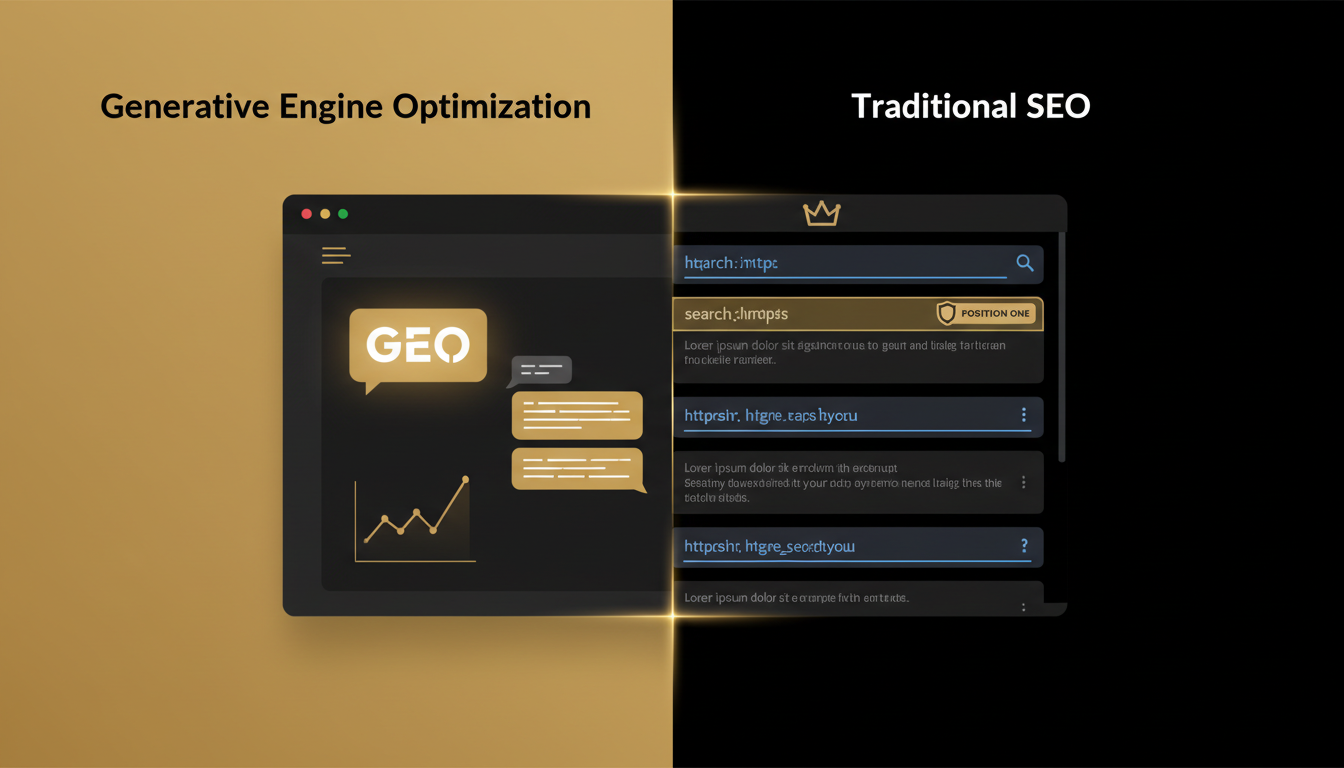
If you've spent years building organic traffic through keyword targeting, link acquisition, and technical audits, the rise of generative engine optimization vs traditional SEO can feel like the rules changed overnight. They did—but not entirely. The core signals that make content trustworthy still matter. What's shifted is how search systems surface that content and what "winning" looks like when the answer appears before any link is clicked.
Quick answer: Generative Engine Optimization (GEO) and traditional SEO share the same foundation—crawlability, authority, and relevance—but diverge sharply in their optimization targets. Traditional SEO earns ranked positions in a list of blue links by accumulating backlinks, targeting keywords, and satisfying technical crawl signals. GEO earns citations inside AI-generated answers produced by Large Language Models (LLMs) and systems like Google AI Overviews. To be quoted by an AI system, content must include concise definitions, structured data, clear entity relationships, and source-worthy passages that an LLM can extract without losing meaning. GEO builds on top of traditional SEO rather than replacing it.
How Traditional SEO Works—and Where It Still Holds
Traditional SEO is built around a well-understood model: search engines crawl pages, index content, and rank results based on hundreds of signals including backlink authority, keyword relevance, page experience, and E-E-A-T (Experience, Expertise, Authoritativeness, and Trustworthiness). The goal is a high position in a list of results, and success is measured by rankings, click-through rate, and organic traffic volume.
That model is not obsolete. The Google SEO Starter Guide still reflects the fundamentals that underpin how Google evaluates pages—and those fundamentals feed directly into AI-driven retrieval. A page that can't be crawled won't be cited. A page with thin content won't be trusted. A page with no backlinks carries less authority weight in any system, AI or otherwise.
What Traditional SEO Gets Right
Traditional SEO excels at:
- Keyword-to-intent matching — mapping content to the specific phrases users type
- Technical health — ensuring pages load fast, are mobile-friendly, and have clean architecture
- Link equity — building domain authority through earned backlinks
- On-page signals — title tags, meta descriptions, header hierarchy, and internal linking
These remain necessary conditions. They are no longer sufficient conditions for capturing AI-driven visibility.
Where Traditional SEO Falls Short in an AI-First Environment
A page ranked #1 for a keyword may never appear in an AI Overview if its content isn't structured for extraction. LLMs don't read a page the way a human does—they identify passages that are self-contained, factually grounded, and clearly attributed to an entity. A 2,000-word article that buries its core answer in paragraph seven is less useful to an AI system than a 400-word section that opens with a direct definition.
What Generative Engine Optimization Actually Changes
Generative Engine Optimization is the practice of structuring content so that AI systems—including Google's AI Overviews, ChatGPT, Perplexity, and other LLM-powered interfaces—select your pages as source material for generated answers. For a deeper treatment of the discipline, the GEO complete guide on this site covers the full framework.
The shift is not cosmetic. GEO requires rethinking what "optimized content" means at the structural level.
From Ranking Signals to Citation Signals
| Signal Type | Traditional SEO Focus | GEO Focus |
|---|---|---|
| Primary goal | Rank in position 1–3 | Be cited in AI-generated answer |
| Keyword use | Match search query terms | Establish entity and topic context |
| Content structure | Headers for crawl hierarchy | Extractable, self-contained passages |
| Backlinks | Domain authority | Source trustworthiness for LLMs |
| Structured data | Rich results eligibility | Entity disambiguation for AI |
| Success metric | Organic click volume | Citation frequency, brand mention share |
| Content format | Long-form for topical depth | Concise definitions + supporting depth |
The Role of Structured Data in GEO
Schema markup was already valuable for rich results in traditional SEO. In a GEO context, it becomes a direct signal to AI systems about what your content is and who produced it. FAQPage schema, Article schema, and Organization schema help LLMs understand entity relationships and content type—making your pages more likely to be selected as a citation source.
The Google Search Central structured data guide explains how structured data communicates meaning to automated systems. Black & Gold SEO's schema automation module applies this at scale, generating and deploying schema without requiring manual markup for every page.
Semantic Search and Entity Context
Semantic search—understanding the meaning behind a query rather than its literal keywords—has been evolving for years. GEO accelerates its importance. LLMs don't retrieve pages by keyword match; they retrieve by conceptual relevance and source credibility. Content that clearly establishes entity relationships (who wrote it, what organization it represents, what topic it covers, and how that topic connects to adjacent concepts) performs better in AI retrieval.
This means internal linking, clear authorship signals, and consistent entity naming across a site all contribute to GEO performance—not just traditional ranking.
What Content Changes Are Actually Required
The practical content changes for GEO are specific and implementable. They don't require abandoning existing content—they require restructuring and augmenting it.
Writing for Extractability
Every major section of a piece should be able to stand alone as an answer. That means:
- Open sections with a direct answer, then support it with detail
- Include concise definitions of key terms near the top of the page
- Use FAQ sections with natural-language questions that mirror how people ask AI systems
- Avoid burying conclusions in summaries at the end
The guide to AI-powered content briefs on this site walks through how to build this structure into the content creation process before writing begins, which is more efficient than retrofitting existing articles.
E-E-A-T as a GEO Signal
Google's helpful content guidance emphasizes demonstrating first-hand experience and genuine expertise. For GEO, E-E-A-T signals serve a dual purpose: they satisfy Google's quality evaluation and they signal to LLMs that a source is trustworthy enough to cite. Accurate claims, clear attribution, and verifiable entity information all contribute.
Getting Into AI Overviews
AI Overviews—Google's AI-generated answer blocks that appear above traditional results—represent the highest-visibility placement in modern search. The guide to getting cited in Google AI Overviews covers the specific signals that influence citation selection, including content freshness, entity clarity, and structured data completeness.
What Matters Most: A Decision Framework
For agencies and site owners deciding where to invest, use this checklist to prioritize:
- Your site has strong technical health (crawlability, speed, mobile-first indexing)
- Core pages have clear entity context (organization, author, topic relationships)
- Key content sections open with direct, quotable answers
- Structured data is implemented for Article, FAQPage, and Organization types
- Internal linking connects related entities and topics consistently
- Content briefs include GEO-specific requirements before writing begins
- Success metrics include citation tracking alongside traditional rank and traffic data
If the first two items aren't in place, GEO optimization will underperform regardless of content quality. Traditional SEO health is the prerequisite.
For agencies managing multiple clients, the AI SEO workflow for agencies shows how to integrate GEO requirements into existing client workflows without rebuilding processes from scratch.
Frequently Asked Questions
What is the main difference between GEO and traditional SEO?
Traditional SEO optimizes pages to rank in a list of blue links by earning backlinks, targeting keywords, and satisfying crawl signals. GEO optimizes content to be quoted or cited inside AI-generated answers, which requires authoritative entity context, concise definitions, structured data, and source-worthy passages rather than just high rankings.
Does traditional SEO still matter if I focus on generative engine optimization?
Yes. Strong traditional SEO—crawlability, page speed, E-E-A-T signals, and quality backlinks—forms the foundation that AI systems use to evaluate source trustworthiness. GEO builds on top of that foundation rather than replacing it.
How do I measure success in GEO compared to traditional SEO?
Traditional SEO is measured by keyword rankings, organic click-through rate, and traffic. GEO success is measured by citation frequency in AI Overviews and LLM responses, brand mention share in AI-generated answers, and zero-click visibility rather than raw click volume.
What content changes are needed to optimize for AI-generated answers?
Content must include concise, quotable definitions, FAQ sections with natural-language questions, structured data markup, clear entity relationships, and authoritative sourcing. Long-form content should be organized so AI systems can extract standalone answer passages without losing context.
Does schema markup help with generative engine optimization?
Yes. Structured data helps AI systems understand entity relationships, content type, and factual claims, making your pages more likely to be selected as a source in AI-generated responses. FAQPage, Article, and Organization schema are especially valuable for GEO.
Sources and Further Reading
- Google helpful content guidance
- Google Search Central structured data guide
- Google SEO Starter Guide
The practical next step is an audit of your highest-traffic pages against the GEO checklist above. Identify which sections can be restructured to open with direct answers, which pages lack structured data, and where entity context is thin. That audit—not a complete content rebuild—is where the measurable gains begin. Black & Gold SEO's technical audit and schema automation modules are built to surface exactly those gaps at scale.
← All posts