How to Build AI-Powered Content Briefs That Rank: Structure, Signals, and Scale
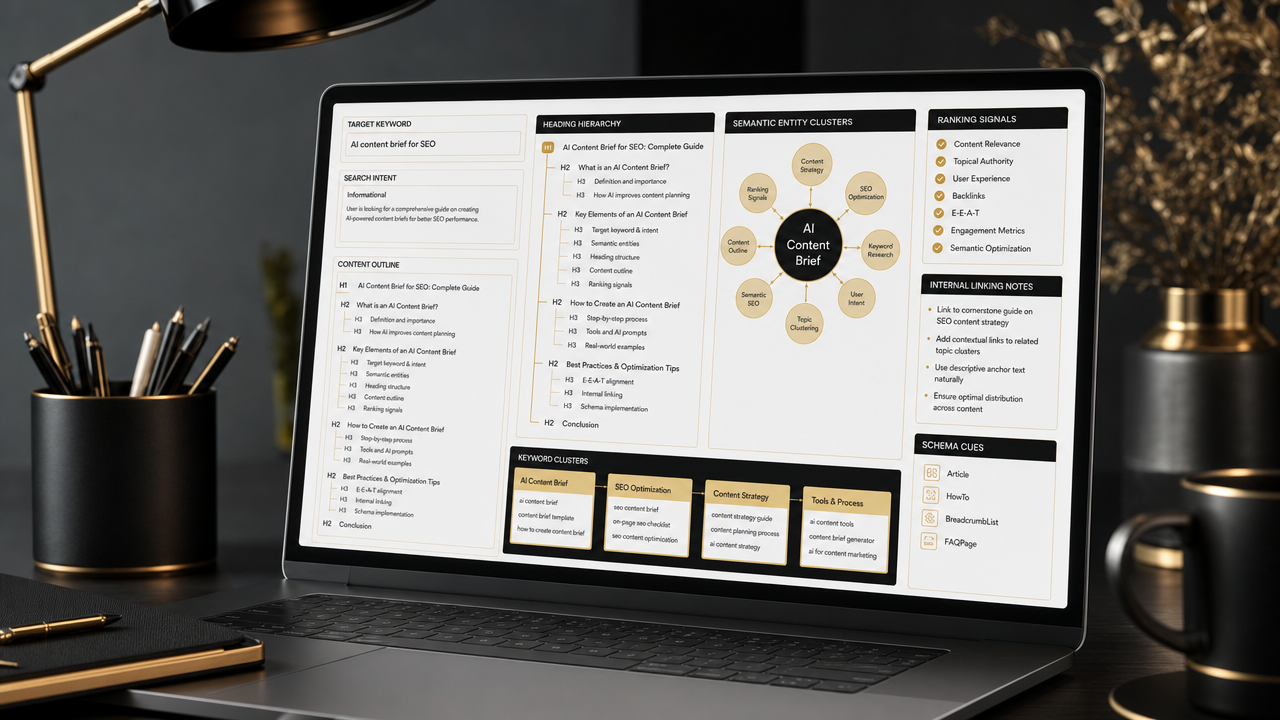
Building AI-powered content briefs is one of the highest-leverage moves an SEO team or agency can make right now. The gap between a page that ranks on page one and one that stalls on page three is rarely about word count alone — it's about how well the content was planned before a single sentence was written. AI-powered content briefs close that gap by encoding ranking signals, semantic structure, and search intent into the brief itself, so writers execute with precision rather than guesswork.
Quick answer: An AI-powered content brief is a structured pre-writing document that combines SERP analysis, semantic entity mapping, competitor gap detection, and E-E-A-T cues to guide writers toward content that satisfies both search algorithms and real users. An effective brief includes the primary keyword, mapped search intent (informational, commercial, navigational, or transactional), a recommended heading hierarchy, semantic entity clusters, suggested word count, internal and external link targets, schema type recommendations, and first-hand experience prompts. When built with AI tooling, these briefs can be produced at 5–10× the speed of manual methods without sacrificing strategic depth, making them essential for agencies managing content at scale.
Why Traditional Content Briefs Fall Short
A traditional brief typically lists a target keyword, a rough outline, and a word count. That approach worked when Google's ranking systems were more keyword-frequency dependent. Today's search algorithms evaluate topical authority, entity relationships, semantic co-occurrence, and user satisfaction signals — none of which a keyword list alone captures.
Manual brief creation also doesn't scale. A strategist spending three hours building one brief can produce perhaps 15 to 20 per month. For agencies managing dozens of clients, that ceiling creates a bottleneck that limits revenue and client outcomes simultaneously.
AI changes the economics and the quality ceiling at the same time.
What Makes an AI-Powered Content Brief Different
Semantic SEO and Entity Mapping
Where a traditional brief might say "include the keyword three times," an AI brief identifies the full semantic neighborhood around a topic. For a page targeting "technical SEO audit," the brief would surface related entities — crawl budget, Core Web Vitals, canonical tags, structured data, XML sitemaps — that Google's NLP systems expect to see co-occurring with that topic.
This entity-level thinking is what separates content that ranks from content that merely exists. The Google SEO Starter Guide makes clear that relevance is about satisfying user needs comprehensively, not repeating phrases mechanically.
SERP-Informed Heading Hierarchy
AI brief tools analyze the top-ranking pages for a query and extract the heading patterns, content formats, and structural signals that correlate with high rankings. The output is a recommended H1, H2, and H3 hierarchy that reflects what the SERP rewards — not what a writer assumes it rewards.
This matters because heading structure is both a ranking signal and a user experience signal. A well-structured page reduces bounce rate, improves dwell time, and increases the probability that an AI answer engine will quote your content directly.
The Anatomy of a Brief That Ranks
What to Include in Every AI-Powered Content Brief
A complete brief should contain all of the following elements. Use this as your production checklist:
- Primary target keyword with mapped search intent (informational, commercial, navigational, or transactional)
- Recommended title tag under 60 characters and meta description under 160 characters
- H1 recommendation aligned to the primary keyword and user intent
- H2/H3 heading hierarchy derived from SERP analysis and competitor gap data
- Semantic entity clusters — the related concepts, entities, and co-occurring terms that establish topical authority
- Competitor content gaps — topics the top-ranking pages cover that your current content misses
- Suggested word count range based on SERP norms for the query type
- Internal link targets — specific pages on your site to link to and from
- External authoritative sources to cite for E-E-A-T credibility
- Schema type recommendation (Article, FAQ, HowTo, Product, etc.)
- E-E-A-T prompts — cues for the writer to include first-hand experience, credentials, or case-specific examples
- Call-to-action alignment — what action should the reader take, and does it match the intent stage?
Encoding Search Intent Correctly
Search intent is the single most critical signal to encode in a brief. A page targeting a commercial-investigation query that reads like a blog post will underperform, and vice versa. AI tools that analyze SERP features — featured snippets, People Also Ask boxes, shopping carousels, local packs — can identify the dominant intent and format expectations for any query with far greater accuracy than manual review.
Getting intent right affects click-through rate, dwell time, and ranking stability. It's the foundation everything else is built on.
How to Build AI-Powered Content Briefs at Scale
The Agency Workflow
For agencies, the value of AI-powered content briefs compounds with volume. A small team using an AI-assisted platform can realistically produce 50 to 200 fully structured briefs per month — compared to 10 to 20 with purely manual methods — without sacrificing strategic depth. The workflow looks like this:
| Stage | Manual Approach | AI-Assisted Approach |
|---|---|---|
| Keyword research | 60–90 min per brief | 5–10 min with clustering |
| SERP analysis | 45–60 min per brief | Automated, real-time |
| Competitor gap detection | 30–45 min per brief | Automated entity comparison |
| Heading hierarchy | Editorial judgment | SERP-derived recommendations |
| Schema recommendation | Requires technical knowledge | Auto-suggested by query type |
| Total time per brief | 3–4 hours | 20–40 minutes |
Platforms like Black & Gold SEO's full feature suite are built specifically for this workflow — combining keyword research, content optimization, and schema automation into a single environment so agencies aren't stitching together five separate tools.
Integrating E-E-A-T Into the Brief
Google's helpful content guidance emphasizes that content should demonstrate first-hand expertise and genuinely satisfy user needs. The brief is where you plan for this — not where you retrofit it after the fact.
Practical E-E-A-T prompts to include in briefs:
- "Include a specific example from client work or direct testing"
- "Cite a named expert or link to a primary source for this claim"
- "Add a 'what we found' or 'in our experience' passage to signal direct knowledge"
- "Reference a specific tool, dataset, or methodology used"
These prompts cost nothing to add to a brief and meaningfully increase the probability that the finished content passes Google's quality signals.
Using Generative AI Content Responsibly
Google's guidance on generative AI content is clear: the method of production is less important than whether the content is helpful, accurate, and people-first. AI briefs that encode quality signals upfront — intent, depth, E-E-A-T cues, entity coverage — make it far easier to use generative AI in the drafting stage without producing thin or misleading content.
The brief is the quality control layer. If the brief is shallow, the AI-generated draft will be shallow. If the brief is comprehensive and strategically sound, generative AI becomes a force multiplier rather than a liability.
What Matters Most: Evaluating Brief Quality
If you're assessing whether a brief (or a brief-generation tool) is worth using, evaluate against these criteria:
- Intent accuracy — Does the brief correctly identify the dominant search intent?
- Entity completeness — Does it surface the semantic neighborhood, not just the primary keyword?
- Competitor gap depth — Does it identify what top-ranking pages cover that yours doesn't?
- Structural specificity — Does it recommend actual headings, not just "include subheadings"?
- Schema guidance — Does it specify which schema type fits the query and content format?
- E-E-A-T integration — Does it prompt writers toward demonstrable expertise, not just word count?
- Actionability — Can a writer follow it without needing additional research?
Pair strong briefs with accurate keyword ranking tracking so you can measure whether the brief's intent mapping is producing ranking movement over time. And if you're selecting the right platform to power this workflow, the SEO audit tool evaluation guide covers the technical foundation that supports content brief quality.
Frequently Asked Questions
What should an AI-powered content brief include to help a page rank?
An effective AI-powered content brief should include the primary target keyword, mapped search intent, a recommended H1 and H2/H3 heading hierarchy, semantic entity clusters, competitor content gaps, suggested word count, internal and external link targets, schema type recommendations, and E-E-A-T signals such as author credentials or first-hand experience cues.
How is an AI content brief different from a traditional content brief?
A traditional content brief relies on manual keyword research and editorial judgment. An AI content brief layers in SERP analysis, semantic co-occurrence data, NLP-derived entity relationships, and real-time competitor signals, allowing writers to target ranking factors that are difficult to identify manually and at a scale that would otherwise require a large research team.
Can AI-generated content briefs help with Google's helpful content requirements?
Yes, when built correctly. AI briefs that encode search intent, E-E-A-T cues, and topical depth prompts guide writers toward people-first content. Google's helpful content guidance emphasizes demonstrating first-hand expertise and satisfying user needs — a well-structured brief ensures those signals are planned before writing begins, not retrofitted afterward.
How many content briefs can an agency realistically produce per month using AI?
With an AI-assisted workflow and a platform that automates SERP analysis, keyword clustering, and competitor gap detection, a small agency team can realistically produce 50 to 200 fully structured content briefs per month — compared to 10 to 20 using purely manual methods — without sacrificing brief quality or strategic depth.
What is the most important ranking signal to encode in a content brief?
Search intent alignment is the single most critical signal. A brief that correctly maps whether the query is informational, commercial, navigational, or transactional ensures the content format, depth, and call-to-action match what Google's algorithm and real users expect, which directly influences click-through rate, dwell time, and ranking stability.
Your Next Step
The fastest way to validate this approach is to build one AI-powered brief for a page that's currently ranking on page two or three, implement the semantic entity gaps and heading restructure it surfaces, and measure ranking movement over 30 to 60 days. That single test will tell you more than any case study. If you want a platform that handles SERP analysis, entity mapping, schema recommendations, and brief generation in one place, explore the Black & Gold SEO services or review pricing to find the tier that fits your agency's volume.