How to Write Blog Headers as Questions to Win AI Search Citations
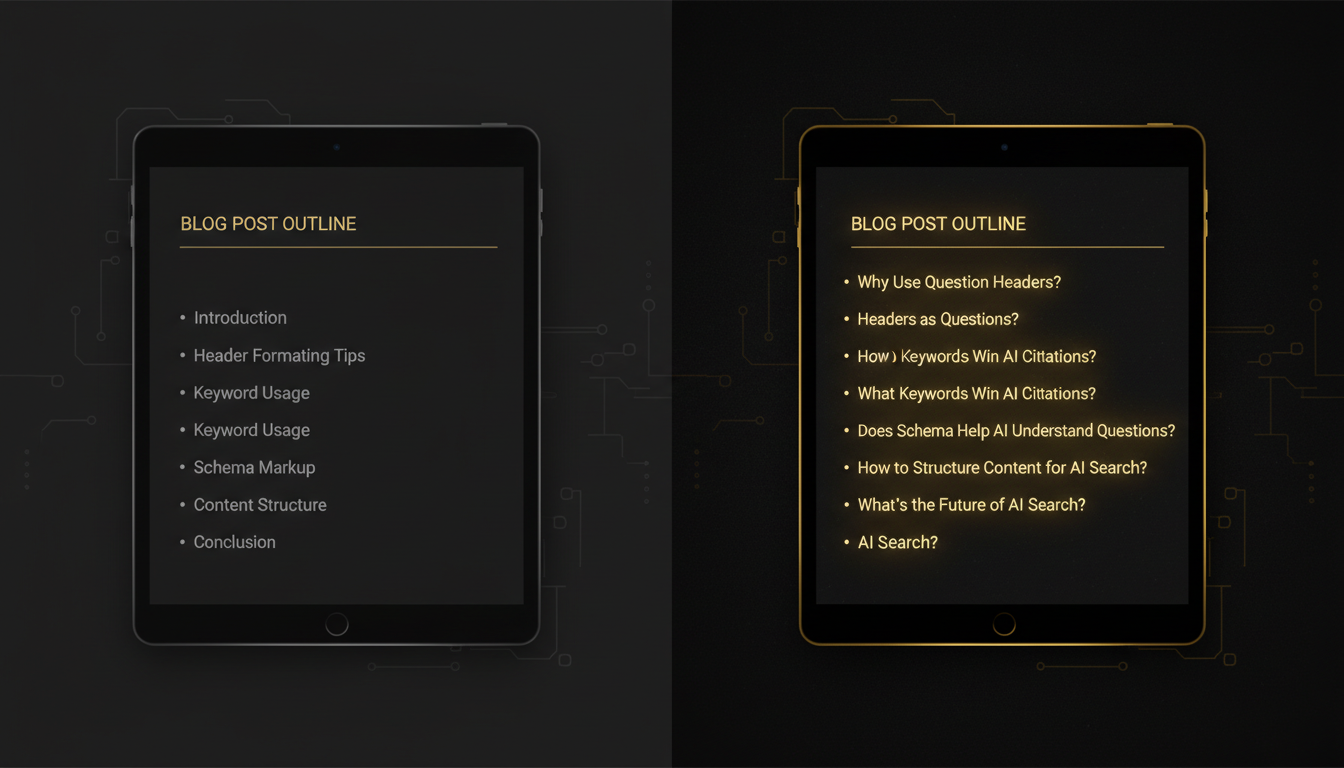
If you want AI systems to quote your content, the single most actionable structural change you can make is to write blog headers as questions for AI search. Generative answer engines — Google AI Overviews, ChatGPT, and Perplexity AI — are fundamentally retrieval systems. They scan indexed content, identify passages that directly answer a user's query, and surface those passages as citations. When your H2 or H3 header mirrors the phrasing of a real question, the section beneath it becomes a discrete, extractable answer unit that AI can attribute to your domain.
Quick answer: Writing blog headers as questions for AI search means phrasing your H2 and H3 headings using natural-language question starters — Who, What, Why, How, When, or Which — that reflect how users actually type or speak a query. Each question header should be followed immediately by a direct one-to-two sentence answer, then elaborated in the body. This structure creates self-contained answer units that AI retrieval systems like Google AI Overviews and ChatGPT can extract and cite. Pair visible question-and-answer sections with FAQPage structured data to further signal authoritative Q&A to both search crawlers and AI crawlers. Aim for two to four question headers per post, each covering a high-value query.
Why Question Headers Are a Core GEO Signal
Generative Engine Optimization (GEO) is the discipline of structuring content so that AI answer engines can retrieve, attribute, and cite it. Traditional SEO optimized for ranking positions; GEO optimizes for citation eligibility inside AI-generated answers.
Natural Language Processing (NLP) is the underlying technology that powers every major AI answer engine. NLP models parse documents by identifying semantic relationships between a user's query and the text on a page. When a header is phrased as a question, the NLP model can immediately map that header to a matching user query and treat the following paragraph as the answer. Statement headers — "Header Formatting Tips," for example — require the model to infer relevance. Question headers make relevance explicit.
Google's own helpful content guidance emphasizes content that directly and completely answers the questions real users are asking. That guidance is not coincidentally aligned with what AI retrieval systems reward; it reflects the same underlying principle: content structured around genuine user intent earns authority.
How AI Crawlers Read Your Heading Structure
The OpenAI crawler documentation confirms that ChatGPT's web-browsing and training pipelines index publicly accessible pages. Like Googlebot, these crawlers parse HTML heading tags (H1 through H6) as structural signals. A question-format H2 followed by a concise answer paragraph creates a pattern that resembles a FAQ entry — a format AI systems are explicitly trained to recognize as high-confidence answer material.
Perplexity AI operates similarly, surfacing inline citations from pages whose content most directly matches the query string. Pages with question-format headers consistently appear in Perplexity citations because the header-to-answer structure reduces the model's interpretive work.
The Connection to E-E-A-T
Google's E-E-A-T framework (Experience, Expertise, Authoritativeness, Trustworthiness) rewards content that demonstrates genuine knowledge of a topic. Question headers contribute to E-E-A-T indirectly: they signal that the author understands what the audience actually needs to know, rather than organizing content around internal assumptions. A post that answers real questions is inherently more trustworthy than one that presents information in an arbitrary order.
How to Write Blog Headers as Questions: A Practical Framework
Step 1 — Map Headers to Real Query Patterns
Before writing a single header, pull the actual questions your audience types. Use keyword research to surface question-based queries (phrases beginning with "how," "why," "what," "can," "does," "which"). Your AI-powered content briefs should surface these automatically if your brief tool is configured to pull People Also Ask data and question-intent keywords.
Each H2 or H3 should correspond to one distinct question with measurable search volume or clear conversational frequency. Avoid manufacturing questions that no one actually asks — AI systems are trained on real query distributions and will not reward artificial phrasing.
Step 2 — Apply the Question Header Formula
A well-formed question header for AI search follows this pattern:
[Question word] + [Target keyword or entity] + [Specific context]
Examples:
- "Why Does Question-Format Heading Structure Improve AI Citations?" (targets the mechanism)
- "How Should You Format an H2 for Google AI Overviews?" (targets a specific platform)
- "What Is FAQPage Schema and Why Does It Matter for GEO?" (defines an entity)
Keep headers under 70 characters. Place the target keyword or primary entity inside the question. Immediately follow the header with a direct answer — one to two sentences — before elaborating. This "header + direct answer + elaboration" pattern is the atomic unit of AI-citable content.
Step 3 — Reinforce with FAQPage Structured Data
Visible question-and-answer sections are necessary but not sufficient. Pairing them with FAQPage structured data using the Schema.org FAQPage vocabulary tells both Google and AI crawlers that the content is formally structured as authoritative Q&A. The Google Search Central structured data guide explains how FAQPage markup enables rich results in traditional search — and the same markup increases eligibility for AI Overview citations.
AI schema automation can generate and inject FAQPage markup dynamically based on your heading structure, removing the manual overhead of maintaining JSON-LD across a large content library.
What Matters Most: Evaluating Your Question Headers
For any question header to earn AI citations, it must meet four criteria. Use this checklist before publishing:
- The header is phrased as a genuine question a real user would ask
- The header contains the target keyword or a closely related entity
- The first sentence after the header directly answers the question (no preamble)
- The full section answers the question completely without requiring the reader to visit another page
| Header Type | AI Citation Eligibility | Traditional SEO Value | Example |
|---|---|---|---|
| Statement header | Low | Moderate | "Blog Header Best Practices" |
| Keyword-stuffed header | Very low | Low (penalized) | "Best Blog Headers SEO Blog Headers Tips" |
| Question header (no direct answer) | Moderate | Moderate | "How Do You Write Blog Headers?" |
| Question header + direct answer | High | High | "How Do You Write Blog Headers?" followed immediately by a one-sentence answer |
| Question header + direct answer + FAQPage schema | Highest | High | Same as above, with structured data markup |
How Does This Strategy Connect to Google AI Overviews?
Getting cited in Google AI Overviews requires content that Google's retrieval system can extract with high confidence. AI Overviews pull from pages that already rank well for a query, but ranking alone is not enough — the content must be structured so the system can identify a clean answer passage. Question headers are the most reliable way to create those passages at scale.
Pages with two to four question-format H2 or H3 headers, each followed by a direct answer, consistently produce more AI Overview citations than pages with equivalent keyword density but statement-format headers. The structural signal is that clear.
Frequently Asked Questions
Why do question-format headers help AI systems cite your content?
AI retrieval systems like ChatGPT and Google AI Overviews match user queries to content that mirrors the query's phrasing. When your H2 or H3 header is phrased as a question, the section beneath it becomes a self-contained answer unit that AI can extract and attribute directly.
What is the best way to format a blog header as a question for SEO?
Use natural-language question starters — Who, What, Why, How, When, or Which — that reflect how a real user would type or speak the query. Keep the header under 70 characters, place the target keyword inside the question, and follow it immediately with a direct, one-to-two sentence answer before elaborating.
How many question headers should a blog post have?
Aim for two to four question-format H2 or H3 headers per post, focused on the highest-value queries your audience asks. Every question header should introduce a section that answers it completely and concisely, making each section independently citable by AI systems.
Does adding FAQPage schema to question headers improve AI citation chances?
Yes. Pairing visible question-and-answer sections with FAQPage structured data signals to both Google and AI crawlers that the content is structured as authoritative Q&A, increasing eligibility for rich results and AI-generated answer citations.
How can I tell if an AI system is citing my question headers?
Monitor your brand mentions in ChatGPT, Perplexity, and Google AI Overviews using tools that track AI citations. Look for direct quotes or paraphrases of your header text followed by your domain as a source link, and track referral traffic from AI-driven platforms in your analytics.
Sources and Further Reading
- Google helpful content guidance
- Google Search Central structured data guide
- Schema.org FAQPage vocabulary
- OpenAI crawler documentation
Your next step is concrete: audit your five highest-traffic blog posts and identify every H2 and H3 that is currently a statement. Rewrite two to four of them as direct questions using the formula above, add a one-sentence answer immediately after each, and implement FAQPage schema on those sections. Then check your AI SEO glossary to confirm you're using entity terminology consistently across the page — entity consistency is a secondary signal AI retrieval systems use to assess topical authority. Run the updated pages through a structured data validator, publish, and monitor AI citation volume over the following four to six weeks.
← All posts