Internal Linking as an AI SEO Signal: Structure, Anchor Text & Crawl Efficiency
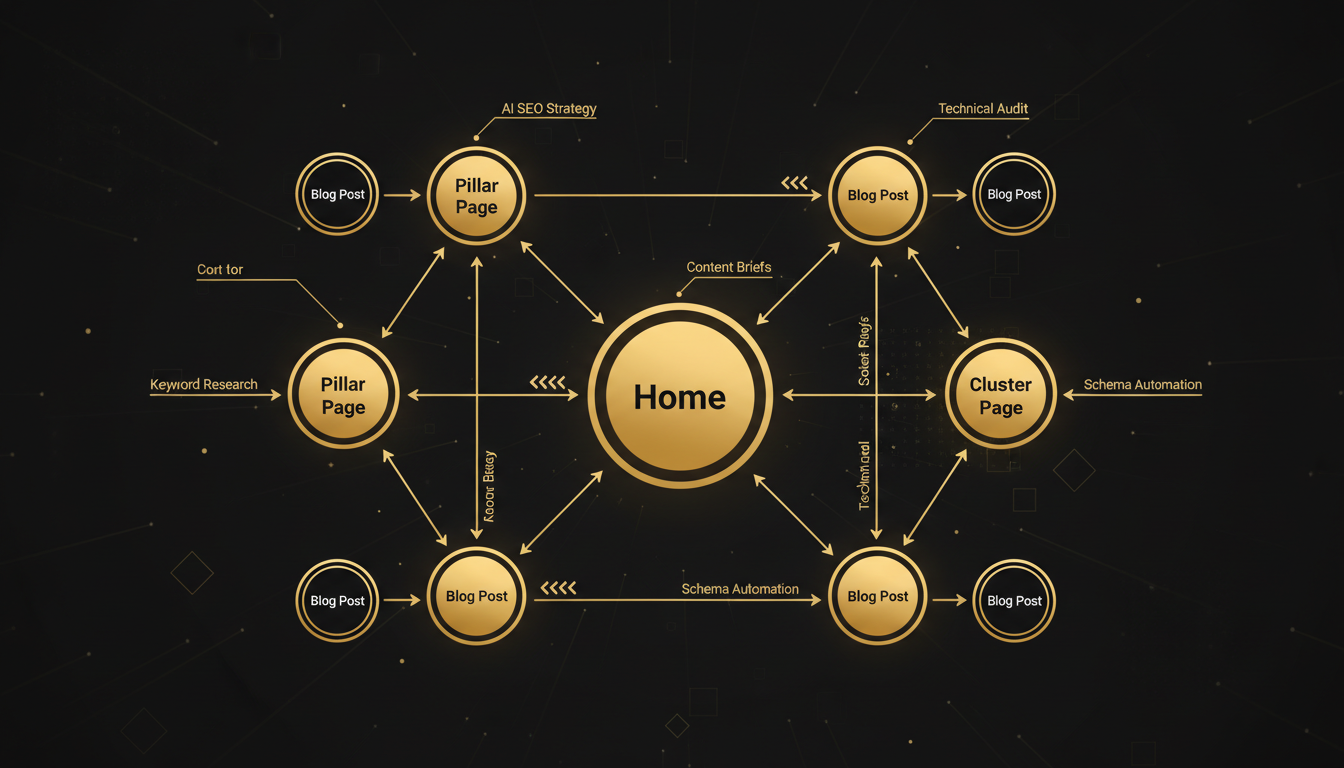
Internal linking has always mattered for SEO, but its role as an internal linking AI SEO signal has grown considerably more complex as generative search engines evaluate site structure to decide what to cite, summarize, and surface in AI-generated answers. Getting your link architecture right is no longer just a crawl-budget exercise — it is a direct input into how AI systems assess your site's topical authority and entity relationships.
Quick answer: Internal linking works as an AI SEO signal by communicating page importance, topical relationships, and entity context to both traditional crawlers and AI retrieval systems. When multiple pages link to a single resource using descriptive, keyword-relevant anchor text, AI models interpret that destination page as authoritative on that subject. A well-structured internal link architecture — with clear pillar-to-cluster relationships, varied but semantically coherent anchor text, and no orphaned pages — increases the probability that your content is retrieved and cited in AI-generated answers. Practically, aim for 3–10 contextual internal links per long-form page, prioritize pillar content and closely related cluster pages, and audit for orphans regularly.
Why Internal Links Matter More in AI-Driven Search
Traditional search engines used internal links primarily to pass PageRank and guide crawlers to new content. That function still exists, but AI search systems — including Google's AI Overviews, Perplexity, and other generative engines — layer on a second evaluation: does this site demonstrate genuine depth on a topic?
Internal links are one of the clearest structural signals available for answering that question. When your blog posts, service pages, and pillar guides reference each other consistently and logically, AI models can map a coherent knowledge graph from your domain. That coherence increases the likelihood your pages are retrieved as authoritative sources rather than skipped in favor of a competitor with a cleaner architecture.
The Google SEO Starter Guide explicitly notes that internal links help Google understand the structure of your site. What has changed is that "structure" now carries semantic weight beyond pure hierarchy.
How to Build an Internal Link Architecture That Signals Authority
Pillar-Cluster as the Foundation
The most durable internal link structure for AI SEO is the pillar-cluster model. A pillar page covers a broad topic comprehensively; cluster pages go deep on specific subtopics and link back to the pillar. Every cluster page also links to at least one or two sibling clusters, creating a web rather than a spoke-and-wheel.
This matters for AI retrieval because generative models assess topical coverage. A site where every article on "technical SEO" links to a central technical SEO guide — and that guide links back to each article — signals that the domain has genuine breadth and depth on the subject. Compare that to a site where articles exist in isolation: AI systems have no structural evidence to confirm expertise.
For agencies running multiple client sites, this architecture also scales. Once you define your pillar topics, every new piece of content has a clear home in the link graph. Our guide on how to use AI for technical SEO audits walks through how automated audits can surface broken link chains and orphaned pages that undermine this structure.
Crawl Efficiency: The Overlooked Dividend
A well-structured internal link architecture is also the most reliable way to improve crawl efficiency. Googlebot and AI crawlers allocate crawl budget based on signals including link depth, crawl frequency of nearby pages, and the presence of sitemaps. Pages buried more than three clicks from the homepage are crawled less frequently and may be deprioritized entirely.
Practical steps to improve crawl efficiency:
- Keep important pages within two to three clicks of the homepage
- Link to new content from existing high-authority pages within 48 hours of publication
- Use Google sitemap guidance to supplement internal links, not replace them
- Audit for orphaned pages quarterly — pages with zero internal links pointing to them are effectively invisible to AI crawlers
- Consolidate thin pages rather than leaving them as dead ends in your link graph
Anchor Text Strategy for AI SEO
Descriptive Over Generic
Anchor text is the label AI systems use to understand what a linked page is about before they visit it. Generic anchors like "click here," "read more," or "this post" provide no semantic signal. Descriptive anchors like "generative engine optimization strategy" or "AI schema automation for structured data" tell both crawlers and AI models exactly what the destination covers.
The practical rule: write anchor text as if you were describing the destination page to a colleague who has never seen it. That description should include the primary topic and, where natural, a relevant keyword phrase.
Variation Without Over-Optimization
Over-optimizing anchor text — using the exact same phrase every time you link to a page — can appear manipulative and flattens the semantic signal. Vary your anchors across linking pages to reflect different facets of the destination's topic. A page about generative engine optimization might be linked as "GEO strategy," "optimizing for AI-generated answers," or "generative engine optimization guide" from different contexts. Each variation reinforces a slightly different entity relationship without repeating the same phrase mechanically.
Anchor Text Checklist
- Use descriptive phrases that reflect the destination page's primary topic
- Include relevant keyword terms naturally — do not force exact-match phrases
- Vary anchor text across different pages linking to the same destination
- Avoid generic anchors (click here, learn more, this article)
- Avoid over-long anchors that read as keyword stuffing
- Match anchor text tone to surrounding sentence context
- Review anchor text distribution in your SEO audit tool quarterly
Internal Linking for Generative Engine Optimization
GEO introduces a dimension that traditional SEO did not require: AI systems are not just indexing pages, they are building entity models of what your site knows. Internal links are one of the primary inputs for that model.
When you link from a page about AI schema automation to a page about content briefs, and from the content briefs page to a page about keyword research, you are drawing a map of related concepts. AI retrieval systems use that map to evaluate whether your site is a coherent source on a topic cluster or a collection of loosely related articles.
This is why the difference between traditional SEO and GEO internal linking is more than philosophical. In traditional SEO, a link passes PageRank. In GEO, a link also asserts a relationship between entities. Getting that relationship wrong — linking a page about local SEO to a page about enterprise schema with no contextual bridge — can dilute the topical signal rather than strengthen it.
Our complete guide to generative engine optimization covers the broader GEO framework, and our post on how to get cited in Google AI Overviews explains how page-level signals including internal link context influence citation likelihood.
What Matters Most: Decision Framework for Internal Link Audits
When auditing or building an internal link strategy, evaluate each decision against these criteria:
| Criterion | Question to Ask |
|---|---|
| Topical relevance | Does this link connect genuinely related topics? |
| Anchor text quality | Does the anchor describe the destination accurately? |
| Crawl depth | Is the destination reachable within 3 clicks from the homepage? |
| PageRank flow | Are high-authority pages linking to pages that need ranking support? |
| Orphan status | Does every important page have at least one contextual inbound link? |
| Reader utility | Would a real reader benefit from following this link? |
| GEO entity signal | Does this link reinforce a coherent topical cluster? |
The Google helpful content guidance frames the underlying principle well: content decisions, including linking decisions, should serve people first. An internal link that exists purely to pass PageRank but confuses or distracts readers is a net negative under both traditional and AI search evaluation.
Building AI-powered content briefs that pre-plan internal link targets before writing is one of the most efficient ways to ensure new content integrates cleanly into your existing architecture from day one.
Frequently Asked Questions
How does internal linking work as an AI SEO signal?
Internal links tell AI search systems which pages are most important and how topics relate. When multiple pages link to a single resource using descriptive anchor text, AI models interpret that page as authoritative on that subject, increasing its likelihood of being cited in AI-generated answers.
What is the best anchor text strategy for internal links?
Use descriptive, keyword-relevant anchor text that accurately reflects the destination page's topic. Avoid generic phrases like 'click here.' Vary anchor text naturally across linking pages to signal topical breadth without over-optimizing any single phrase.
How many internal links should a page have?
There is no fixed limit, but every internal link should serve the reader. A practical guideline is 3–10 contextual internal links per long-form page, prioritizing links to pillar content, closely related cluster pages, and high-converting destination pages.
Does internal linking improve crawl efficiency?
Yes. A well-structured internal link architecture ensures Googlebot and AI crawlers can discover and re-crawl important pages faster. Orphaned pages with no internal links are crawled less frequently and may be deprioritized in AI retrieval systems.
How is internal linking different for generative engine optimization compared to traditional SEO?
In traditional SEO, internal links primarily pass PageRank and aid indexation. In GEO, internal links also signal topical clusters and entity relationships that AI models use to assess a site's depth of expertise, making consistent, semantically coherent link structures more important than ever.
Sources and Further Reading
The most practical next step is to run a full internal link audit on your site right now: identify orphaned pages, map your pillar-cluster relationships, and review anchor text distribution across your top 20 pages. If you are managing multiple client sites, that audit process is exactly where an AI-powered SEO platform pays for itself — surfacing structural gaps in minutes rather than days, so you can focus on fixing the links that will move the needle on both rankings and AI search retrieval.
← All posts