How to Build a White-Label SEO Reporting System for Agencies
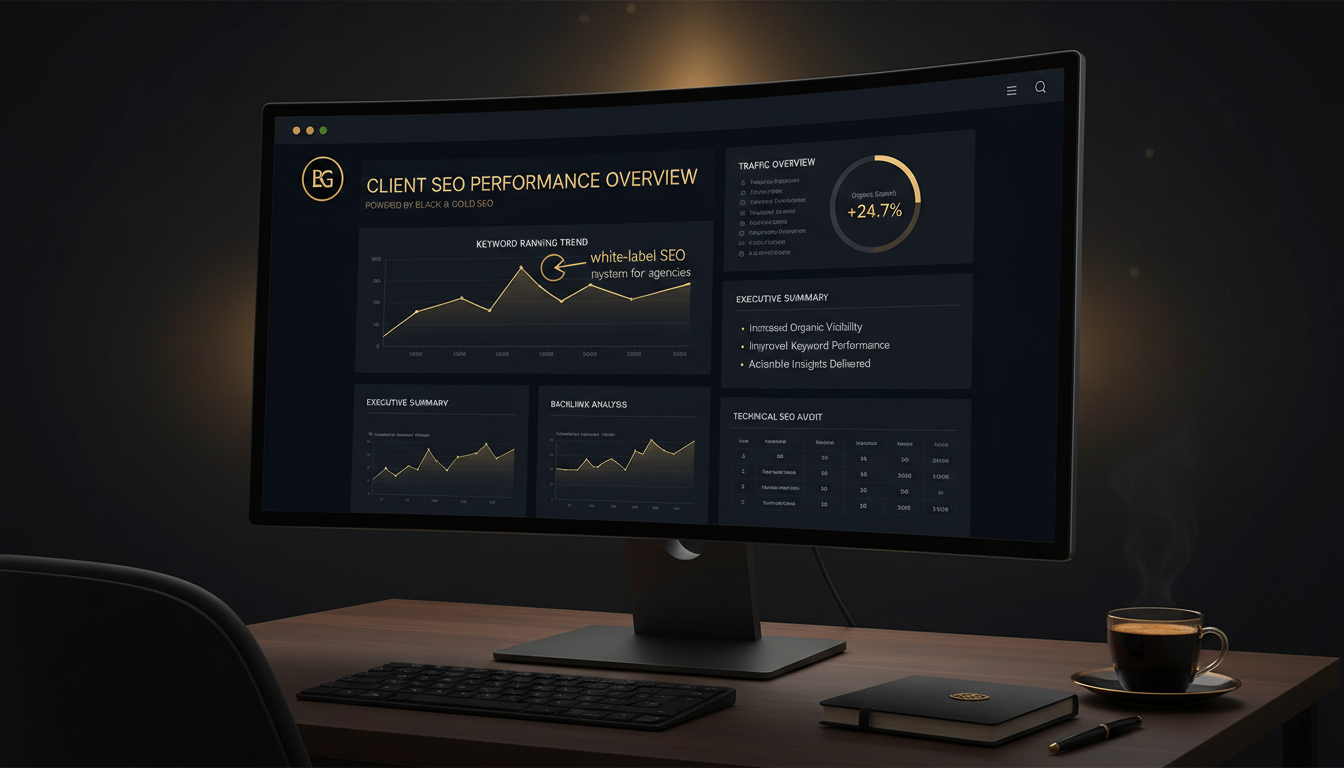
Building a white-label SEO reporting system for agencies is one of the highest-leverage investments a growing agency can make. Done right, it transforms scattered data from rank trackers, audit tools, and analytics platforms into a single branded experience that clients actually read—and that keeps them renewing month after month.
Quick answer: A white-label SEO reporting system for agencies is a branded reporting infrastructure that pulls keyword rankings, technical audit results, backlink data, organic traffic trends, and AI-generated executive summaries into client-facing dashboards and PDFs that carry the agency's logo, not the tool's. To build one, agencies need four components: a unified data layer (rank tracking, audits, analytics), a reporting engine that formats and schedules output, white-label branding controls (logo, color scheme, custom domain), and an AI summary layer that translates raw metrics into plain-language insights executives can act on. The result is a repeatable, scalable deliverable that demonstrates value at every billing cycle without requiring manual assembly.
Why Most Agency Reporting Systems Break Down
Most agencies cobble together reports from three to six separate tools—one for rank tracking, another for technical audits, a third for backlinks, and a spreadsheet for everything else. The result is a fragmented workflow that takes hours per client, produces inconsistent output, and still fails to answer the one question every client actually asks: "Is our SEO working?"
The problem is structural. When data lives in silos, the reporting layer becomes a manual translation job. An agency managing fifteen clients cannot afford to spend four hours per client per month assembling reports. That math kills margins and burns out account managers.
A purpose-built white-label SEO reporting system solves this by centralizing data ingestion, automating formatting, and applying consistent branding rules across every client account. The goal is not just efficiency—it is a repeatable, professional deliverable that positions the agency as a strategic partner rather than a vendor.
What a Complete White-Label SEO Reporting System Requires
The Four Core Data Layers
Before choosing a platform or designing a template, map the data your reports must include. A complete white-label SEO report needs:
| Data Layer | What It Measures | Why Clients Care |
|---|---|---|
| Keyword Rank Tracking | Position changes by keyword and page | Directly visible progress |
| Technical SEO Audit | Crawl errors, Core Web Vitals, indexability | Site health and risk |
| Organic Traffic Trends | Sessions, clicks, impressions from Search Console | Business impact |
| Backlink Growth | New links, lost links, domain authority trends | Authority building |
| On-Page Optimization Scores | Title tags, meta, content quality signals | Content ROI |
| AI Executive Summary | Plain-language interpretation of all above | Stakeholder alignment |
Skipping any layer creates a report that feels incomplete to clients and forces account managers to fill gaps verbally—which is not scalable.
Branding Controls That Actually Matter
White-labeling is more than dropping a logo on a PDF. A proper system gives agencies control over:
- Custom logo and color palette applied globally across all client reports
- Custom domain or subdomain for live dashboards (e.g.,
reports.youragency.com) - Removal of all third-party tool branding from exports and email notifications
- Editable cover pages and executive summary fields
- Client-specific report naming conventions
Agencies that skip the custom domain step undermine their own positioning. When a client sees a third-party tool URL in their dashboard link, the agency's value is immediately diluted.
How to Structure the Build: A Step-by-Step Framework
Step 1: Choose a Platform That Unifies Data Natively
The fastest path to a working white-label SEO reporting system is an AI-powered SEO platform that handles technical audits, rank tracking, backlink monitoring, and on-page analysis in a single environment. Platforms that require third-party integrations for every data source introduce sync failures, data latency, and maintenance overhead.
When evaluating platforms, the decision framework should prioritize:
- Native rank tracking with accurate daily or on-demand updates (see how to track keyword rankings accurately for evaluation criteria)
- Built-in technical audit engine, not a third-party API wrapper
- White-label controls at the workspace or client level, not just the account level
- AI-generated summaries that interpret data in plain language
- Scheduled report delivery via email or live dashboard link
For a broader comparison of what to look for, the best SEO software for agencies breaks down platform capabilities across these dimensions.
Step 2: Build a Repeatable Report Template
A report template is not a design exercise—it is a communication strategy. Structure every client report around a logical narrative:
- Executive summary — Three to five sentences on overall trajectory, written for a non-technical stakeholder
- Keyword performance — Top movers, new rankings, losses, and featured snippet appearances
- Organic traffic — Month-over-month and year-over-year trends with annotated context
- Technical health — Open issues prioritized by impact, with status tracking from prior periods
- Backlink activity — Net new links, lost links, and domain authority movement
- Next-step recommendations — Specific, actionable items tied to the data above
The executive summary is the most important section and the most commonly skipped. Clients who do not understand a report do not value it. For a deeper treatment of this, how to build client-ready SEO reports executives read covers the narrative structure in detail.
Step 3: Automate Delivery and Scheduling
Manual report delivery is a retention risk. If a report is late, clients notice. If it is inconsistent, they question the agency's processes. Automation removes both risks.
Set up:
- Scheduled PDF exports or live dashboard links sent on a fixed cadence (weekly for active campaigns, monthly for maintenance accounts)
- Automated alerts for significant ranking changes or new technical errors between reporting cycles
- Client-specific email templates that carry the agency's branding
Automating SEO reporting across multiple clients covers the technical setup for agencies managing large client portfolios.
Step 4: Layer in AI and GEO Signals
Modern SEO reporting cannot ignore Generative Engine Optimization. As AI answer engines like Google AI Overviews, ChatGPT, and Perplexity become primary discovery surfaces, clients need visibility into whether their content is being cited—not just ranked.
An advanced white-label SEO reporting system should track:
- AI Overview appearances for target keywords
- Schema markup coverage and validation status (the Google Search Central structured data guide defines what structured data types are eligible for rich results)
- Content authority signals that influence GEO citation likelihood
Incorporating GEO metrics into client reports differentiates an agency from competitors still reporting only on blue-link rankings. For the workflow behind this, the AI SEO workflow for agencies outlines how to integrate GEO tracking into an existing reporting cadence.
What Matters Most: Evaluation Checklist
When assessing whether your current or prospective reporting system is truly white-label-ready, use this checklist:
- All client-facing URLs, dashboards, and PDFs carry your agency's branding, not the tool's
- Rank tracking data updates at a frequency appropriate to campaign activity
- Technical audit findings are prioritized by business impact, not just severity score
- Reports include an AI-generated executive summary in plain language
- Delivery is fully automated on a client-specific schedule
- Schema and structured data coverage is tracked and reported
- GEO and AI Overview visibility is included alongside traditional rank data
- The platform supports the Google SEO Starter Guide fundamentals as a baseline for audit criteria
How White-Label Reporting Directly Affects Client Retention
Agencies that report consistently and clearly retain clients longer. The mechanism is straightforward: clients who see measurable progress in a format they understand do not question the engagement. Clients who receive dense data dumps or irregular reports fill the uncertainty with doubt.
Branded, scheduled, AI-summarized reports create a rhythm of accountability. Each report cycle becomes a touchpoint that reinforces the agency's value without requiring a call or a presentation. Over a twelve-month engagement, that cadence compounds into a relationship built on demonstrated results rather than promises.
Frequently Asked Questions
What is a white-label SEO reporting system?
A white-label SEO reporting system lets agencies deliver branded SEO performance reports to clients under their own agency name and logo, hiding the underlying tools or platform used to generate the data.
How do agencies automate SEO reports for multiple clients?
Agencies automate SEO reports by connecting rank tracking, audit, and analytics data to a reporting platform that schedules and sends branded PDF or live-dashboard reports to each client on a set cadence—daily, weekly, or monthly.
What data should a white-label SEO report include?
A complete white-label SEO report should include keyword ranking changes, organic traffic trends, technical audit findings, backlink growth, on-page optimization scores, and an AI-generated executive summary with clear next-step recommendations.
Can small agencies afford a white-label SEO reporting platform?
Yes. Many AI-powered SEO platforms offer agency-tier plans that include white-label reporting for a flat monthly fee, making it cost-effective even for agencies managing five to twenty clients.
How does white-label SEO reporting help with client retention?
Consistent, branded, easy-to-read reports demonstrate measurable progress, build trust, and reduce client churn by making the agency's value visible every reporting cycle rather than only during quarterly reviews.
Sources and Further Reading
The practical next step is to audit your current reporting workflow against the checklist above. Identify which data layers are missing, where manual assembly is consuming the most time, and whether your current output carries your agency's brand or a tool vendor's. From there, the build becomes a sequenced project rather than an overwhelming overhaul—and the first client report that goes out fully automated, fully branded, and AI-summarized will make the investment immediately visible.
← All posts