AI Keyword Research: Find High-Intent Topics Competitors Miss
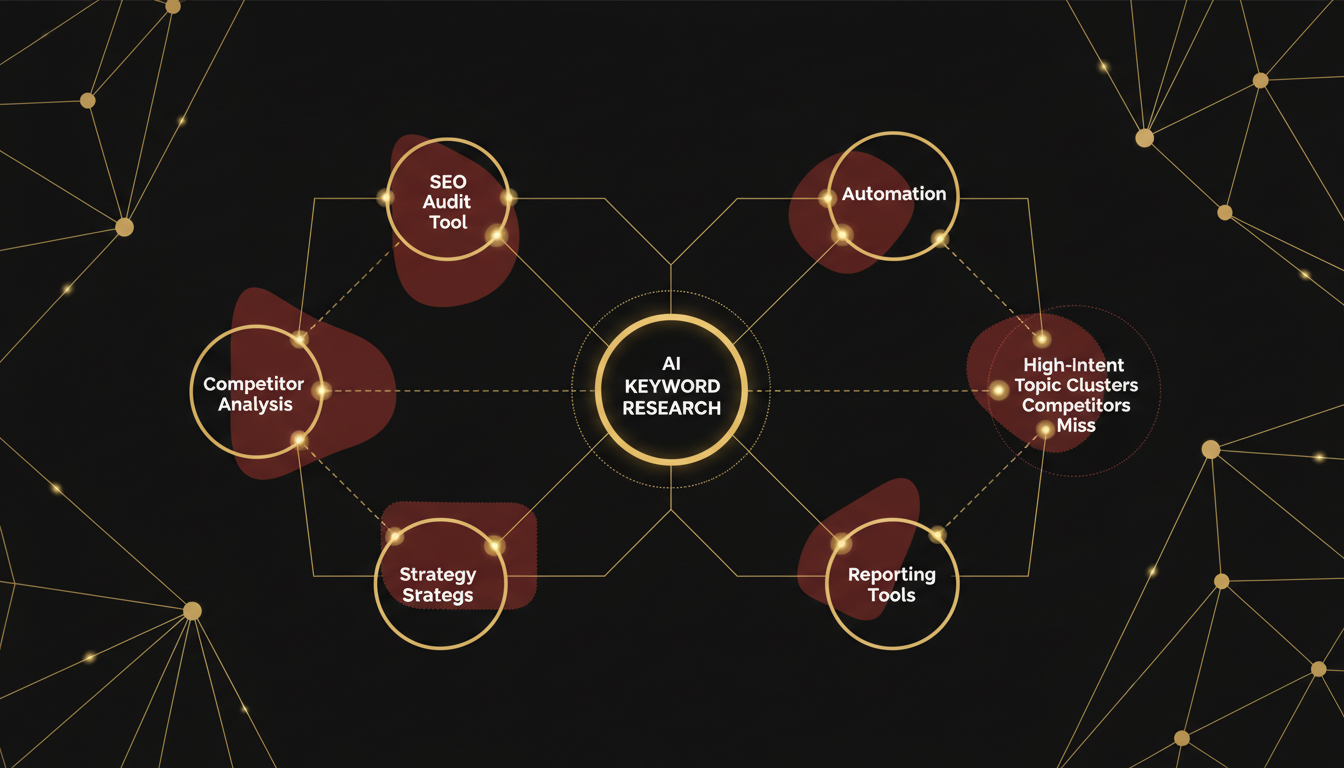
Most keyword research tools hand you the same list of high-volume terms your competitors already target. AI keyword research for high-intent topics works differently — it surfaces the semantically rich, lower-competition queries that signal genuine purchase or action readiness, the ones sitting in the gaps between what your rivals publish and what searchers actually need.
Quick answer: AI keyword research goes beyond volume and competition scores to analyze searcher intent signals, semantic relationships, and content gaps across competitor sites simultaneously. For agencies and site owners, this means identifying high-intent, long-tail keyword clusters that traditional tools miss — topics where a searcher is close to taking action and where competitor content is thin or absent. The practical workflow involves feeding seed topics into an AI-powered platform, clustering semantically related queries by intent stage, running a gap analysis against top-ranking competitors, and prioritizing topics where intent is strong but existing content is weak. Done correctly, this approach consistently surfaces conversion-ready opportunities before competitors discover them.
Why Traditional Keyword Research Leaves High-Intent Topics on the Table
Standard keyword tools rank terms by monthly search volume and a keyword difficulty score. Both metrics are useful, but they share a structural blind spot: they measure what is already popular, not what is strategically underserved.
High-volume terms attract the most competition. By the time a keyword appears at the top of a volume-sorted report, dozens of well-resourced sites are already targeting it. The result is a race to outspend competitors on content and links for terms that may never convert efficiently.
High-intent keywords — queries that signal a searcher is ready to buy, book, or solve an urgent problem — often appear mid-funnel or deep in the long tail. They carry lower search volume but dramatically higher conversion potential. A query like "AI SEO audit tool for small agencies with white-label reporting" will never top a volume chart, yet a visitor typing that phrase is far closer to signing up than someone searching "what is SEO."
The Role of Semantic Search in Surfacing Intent
Modern search engines do not match keywords to pages; they match meaning to meaning. Google's systems understand that "best AI SEO platform for agencies," "AI-powered SEO software for agencies," and "top SEO automation tools for agency teams" are semantically related queries representing the same underlying intent. Pages that address the full semantic neighborhood of a topic outperform pages that target a single phrase.
AI keyword research tools exploit this by mapping semantic clusters — groups of related queries that share intent context — rather than treating each keyword as an isolated data point. The output is a topic architecture, not a keyword list.
What Content Gap Analysis Actually Reveals
A content gap analysis compares your site's topic coverage against multiple competitors at once. The gaps it surfaces fall into three categories:
- Missing topics: Subjects competitors rank for that you have not addressed at all.
- Weak coverage: Topics you have touched but where competitor pages are significantly more comprehensive.
- Intent mismatches: Pages you have published that target the wrong stage of the funnel for the queries driving traffic to them.
The third category is the most overlooked and often the most valuable. An informational page ranking for a high-intent query is leaving conversions on the table. Restructuring or splitting that content to match intent can lift conversions without requiring new link acquisition.
For a deeper look at running this analysis systematically, see the guide on AI competitor analysis and SEO content gaps.
How to Run AI Keyword Research for High-Intent Topics
Step 1: Build Semantically Rich Seed Lists
Start with your core service or product categories, not individual keywords. Feed those categories into an AI keyword research tool alongside your top three to five competitors' domains. The tool should return not just keyword suggestions but intent classifications — informational, navigational, commercial, transactional — and semantic cluster groupings.
For an agency platform like Black & Gold SEO, useful seed categories might include "AI SEO audit," "content brief automation," "backlink outreach for agencies," and "generative engine optimization." Each seed expands into a cluster of semantically related queries at multiple intent stages.
Step 2: Filter by Intent Stage and Conversion Proximity
Sort your keyword clusters by intent stage before touching volume or difficulty. Prioritize:
- Transactional and commercial investigation queries first — these are closest to conversion.
- Problem-aware queries second — searchers who know they have a problem and are evaluating solutions.
- Informational queries third — useful for building topical authority but rarely the highest-ROI starting point.
Within each intent stage, look for clusters where competitor content is thin, outdated, or mismatched to the query's actual intent. These are your highest-leverage opportunities.
Step 3: Apply Keyword Clustering Before Creating Content
Keyword clustering groups semantically related queries under a single content target, preventing cannibalisation and ensuring each page covers its topic comprehensively. A well-clustered content plan means fewer pages competing against each other and stronger topical authority signals to search engines.
A practical clustering checklist before you write:
- Group all queries sharing the same primary intent under one target URL.
- Identify supporting subtopics that belong as H2 or H3 sections within the page.
- Flag question-based variants for FAQ schema inclusion.
- Note entity relationships — brands, tools, concepts — that should appear naturally in the content.
- Check whether any cluster is large enough to warrant a hub page with supporting spokes.
Once clusters are defined, use them to build structured content briefs. The guide on building AI-powered content briefs that rank covers how to translate cluster data into briefs that writers and AI tools can execute accurately.
Comparing AI Keyword Research to Traditional Approaches
| Dimension | Traditional Keyword Research | AI Keyword Research |
|---|---|---|
| Primary signal | Search volume + difficulty score | Intent signals + semantic relationships |
| Competitor analysis | Manual, one competitor at a time | Automated gap analysis across multiple competitors |
| Keyword grouping | Manual or basic match-type grouping | Semantic clustering by intent stage |
| Long-tail discovery | Limited by seed expansion depth | Deep semantic expansion from topic context |
| Content gap identification | Requires separate tools | Integrated into the keyword workflow |
| GEO/AI answer engine readiness | Not considered | Surfaces entity-rich, quotable phrases |
Connecting AI Keyword Research to Generative Engine Optimization
Search behavior is shifting. A growing share of queries are answered directly by AI systems — Google AI Overviews, ChatGPT, Perplexity — without a traditional click. Appearing in those AI-generated answers requires a different optimization target than ranking in the ten blue links.
AI keyword research helps here in a specific way: it identifies the exact questions, definitions, and entity-rich phrases that AI answer engines tend to cite. When you structure content around those phrases — with concise definitions, direct answers, and clear entity context — you improve your probability of being quoted in AI responses, not just ranked.
This is the core discipline of generative engine optimization (GEO). For a complete framework, the GEO complete guide covers how to structure content for AI retrieval alongside traditional ranking.
What Matters Most When Evaluating AI Keyword Research Tools
When assessing any AI keyword research platform for agency use, the decision framework should weight these factors:
- Intent classification accuracy: Does the tool correctly distinguish transactional from informational queries?
- Semantic cluster quality: Are related queries grouped meaningfully, or is it just alphabetical bucketing?
- Competitor gap depth: Can it analyze multiple competitors simultaneously and surface genuine gaps?
- Integration with content workflows: Does keyword data flow directly into content briefs and on-page recommendations?
- Rank tracking integration: Can you measure whether targeted clusters are moving? See how to track keyword rankings accurately for the measurement side of this workflow.
- GEO readiness signals: Does the tool flag entity-rich, question-based phrases suited for AI answer engine optimization?
Following Google's helpful content guidance and the Google SEO Starter Guide remains the baseline — AI tools should amplify a people-first content strategy, not replace it.
Frequently Asked Questions
How does AI keyword research differ from traditional keyword research?
Traditional keyword research ranks terms by search volume and competition score. AI keyword research also analyzes searcher intent signals, semantic relationships between topics, and content gaps in competitor pages — surfacing high-intent, lower-competition opportunities that volume-only tools routinely miss.
What is a high-intent keyword and why does it matter for SEO?
A high-intent keyword signals that the searcher is close to taking a specific action — making a purchase, booking a service, or solving an urgent problem. Targeting high-intent keywords typically produces better conversion rates and stronger ROI than chasing broad, informational terms with high volume but low purchase readiness.
How can I find keyword topics my competitors are missing?
Run an AI-powered content gap analysis that compares your site's topic coverage against multiple competitors simultaneously. Look for semantically related subtopics, question-based queries, and long-tail variants that competitors rank for weakly or not at all — these represent your highest-leverage content opportunities.
Can AI keyword research help with generative engine optimization?
Yes. AI keyword research identifies the specific questions, definitions, and entity-rich phrases that AI answer engines like Google AI Overviews and ChatGPT tend to cite. Structuring content around those phrases improves your chances of being quoted in AI-generated responses, not just ranked in traditional results.
How often should agencies refresh AI keyword research for client campaigns?
Most agencies benefit from a full AI keyword refresh every 60 to 90 days, with lightweight intent-signal monitoring monthly. Search behavior shifts faster in competitive niches, so setting automated rank-tracking alerts alongside periodic gap analyses keeps your content strategy ahead of competitor moves.
Sources and Further Reading
The practical next step is to pick one service or product category, run a semantic cluster analysis against your top three competitors, and identify the five highest-intent gaps where their content is thinnest. Build those five pages or sections first — they will deliver measurable ranking and conversion movement faster than any broad informational content push. Explore the Black & Gold SEO platform features to see how keyword research, gap analysis, and content briefs connect in a single workflow built for agencies.
← All posts