SaaS SEO in 2026: The Complete Strategy Guide
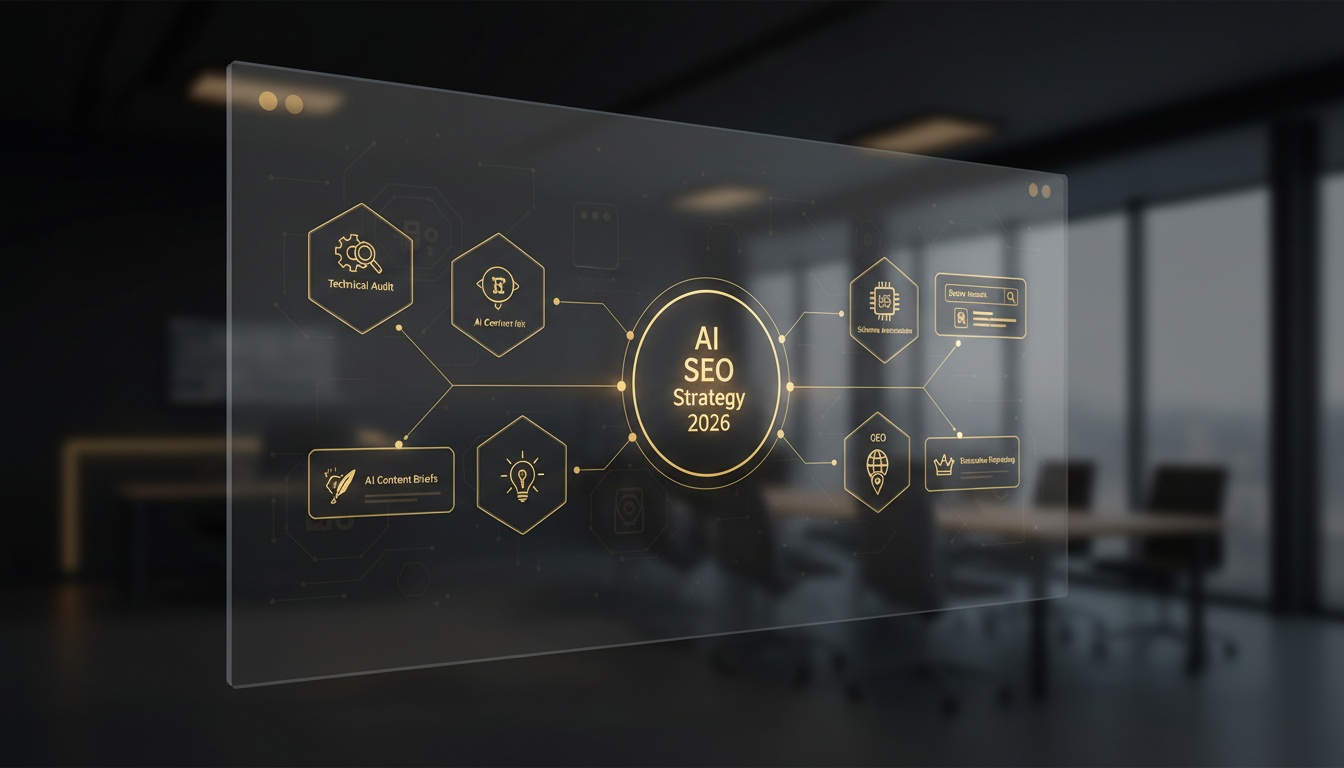
If you're building or scaling a SaaS company, a well-executed SaaS SEO strategy in 2026 is one of the highest-ROI growth levers available — but the rules have shifted significantly. Google's AI Overviews now answer queries before users click a single result. Generative AI tools like ChatGPT and Perplexity cite sources directly. And technical debt in SaaS apps can silently kill organic visibility overnight. Getting this right requires a unified approach that spans technical health, topical authority, structured data, and AI-native content optimization.
Quick answer: A SaaS SEO strategy in 2026 must address four interconnected pillars: (1) technical SEO health across dynamic app URLs and crawl architecture, (2) topical authority built through high-intent keyword clusters mapped to the buyer journey, (3) schema markup automation that makes your product, pricing, and FAQs machine-readable for Google and AI answer engines, and (4) generative engine optimization (GEO) so your SaaS earns citations in AI Overviews and LLM-powered search. Companies that treat these as separate workstreams lose ground to competitors running them as a single, compounding system. Measurable organic pipeline impact typically appears within six to twelve months of a structured program.
Why SaaS SEO Is Different From Standard SEO
SaaS companies face a unique set of organic search challenges that generic SEO playbooks don't address well.
The Buyer Journey Is Longer and More Keyword-Complex
A SaaS buyer might search "what is project management software," then "best project management tools for remote teams," then "[competitor] alternative," and finally "[your brand] pricing" — all before booking a demo. Each stage requires a different content type, a different keyword intent, and a different conversion path. SaaS SEO must map content to every stage of that journey, not just the bottom of the funnel.
Dynamic URLs and App Architecture Create Crawl Risk
SaaS platforms generate thousands of parameterized, session-based, or user-specific URLs that can leak into Google's index and dilute crawl budget. Without a rigorous technical audit process, these issues compound quietly until rankings drop. The Google SEO Starter Guide covers canonical tags and crawl directives as foundational controls — SaaS teams should treat these as non-negotiable infrastructure, not optional cleanup.
Building Your SaaS SEO Strategy: The Core Framework
Start With a Technical SEO Audit
Before publishing a single new piece of content, audit your existing technical foundation. For SaaS, this means checking:
- Core Web Vitals across app and marketing site pages
- Crawl budget allocation and index bloat from dynamic URLs
- Internal link architecture connecting feature pages, use-case pages, and blog content
- Canonical tag implementation across staging and production environments
- Structured data validity and coverage
A thorough technical audit surfaces the issues that suppress rankings regardless of content quality. If you want to understand how AI is changing the audit process itself, the guide on how to use AI for technical SEO audits covers modern approaches in depth.
Map Keywords to the SaaS Buyer Journey
Keyword research for SaaS is not about volume alone — it's about intent mapping. High-intent bottom-of-funnel terms like "[category] software for [use case]" or "[competitor] vs [your brand]" drive demo requests and trial signups. Mid-funnel educational terms build topical authority and warm audiences. Top-of-funnel definitional content earns AI citations.
A practical keyword framework for SaaS looks like this:
| Funnel Stage | Intent Type | Example Query Format | Primary Goal |
|---|---|---|---|
| Top of Funnel | Informational | "What is [category]?" | AI citation, brand awareness |
| Middle of Funnel | Comparative | "Best [category] tools" | Organic traffic, list inclusion |
| Bottom of Funnel | Transactional | "[Brand] pricing / demo" | Trial signups, demo bookings |
| Retention/Expansion | Navigational | "[Brand] [feature] how-to" | Reduce churn, upsell |
For a deeper look at finding high-intent topics your competitors are missing, see the post on AI keyword research for high-intent topics.
Topical Authority: The Compounding Advantage
Topical authority is the degree to which Google and AI systems recognize your site as a comprehensive, trustworthy source on a given subject. For SaaS companies, this means owning a cluster of related topics — not just ranking for isolated keywords.
How to Build Topical Authority for SaaS
Building topical authority requires a deliberate content architecture:
- Pillar pages that cover a core topic comprehensively (e.g., "The Complete Guide to [Your Category]")
- Cluster content that addresses specific subtopics, use cases, and questions in depth
- Internal linking that connects cluster content back to pillar pages and feature/landing pages
- Consistent publishing cadence that signals ongoing expertise to crawlers and AI systems
The goal is for Google's systems — and AI answer engines — to associate your domain with the entire semantic neighborhood of your category, not just a handful of keywords.
E-E-A-T Signals That Matter for SaaS
Google's E-E-A-T framework (Experience, Expertise, Authoritativeness, Trustworthiness) is especially important for SaaS companies making product claims. Practical signals include:
- Author pages with verifiable credentials and product experience
- Accurate, up-to-date feature descriptions that match the live product
- Customer case studies with specific, verifiable outcomes
- Transparent pricing pages (even ranges) that reduce user uncertainty
- Third-party review citations from G2, Capterra, or similar platforms
The Google helpful content guidance frames this clearly: content should demonstrate firsthand experience and serve the reader's actual need, not just match a keyword.
Schema Markup Automation for SaaS
Structured data is one of the highest-leverage, most under-utilized tactics in SaaS SEO. Schema markup tells Google and AI systems exactly what your product is, what it costs, what users say about it, and what questions it answers.
What Schema Types Matter Most for SaaS
- SoftwareApplication — communicates your product category, operating system, pricing, and aggregate rating
- FAQPage — surfaces question-and-answer content directly in search results and AI Overviews
- Organization — establishes entity context for your brand, including logo, social profiles, and founding information
- Review / AggregateRating — pulls verified review data into rich results
Manual schema implementation at scale is error-prone and slow. Automated schema generation — tied directly to your content and product data — ensures coverage stays current as your site evolves. The Google Search Central structured data guide provides the technical specification; the post on AI schema automation for SEO and AI answer engines covers how to implement this efficiently at scale.
Generative Engine Optimization (GEO): The 2026 Imperative
GEO is no longer optional for SaaS brands. Google AI Overviews now appear for a significant share of informational and comparative queries — exactly the queries SaaS buyers use early in their research. If your content isn't structured to be cited, a competitor's will be.
What Makes SaaS Content GEO-Ready
- Concise, quotable definitions near the top of each page
- Direct answers to specific questions rather than vague overviews
- Entity context — clearly naming your product, category, and use cases in ways that match how AI systems model the topic
- Schema markup that reinforces the same entity relationships in machine-readable form
- Authoritative sourcing — linking to credible external references where appropriate
The complete framework for GEO is covered in the generative engine optimization complete guide.
AI-Powered Content Briefs: Scaling Without Sacrificing Quality
One of the biggest bottlenecks for SaaS SEO teams is producing enough high-quality content to build topical authority without diluting E-E-A-T. AI-powered content briefs solve this by giving writers a structured, research-backed starting point that includes target keywords, competitor gaps, required entities, schema recommendations, and internal link opportunities.
The result is faster production cycles and more consistent quality — without the thin, generic output that AI writing tools produce when used without a structured brief. The guide on how to build AI-powered content briefs that rank walks through the process in detail.
SaaS SEO Execution Checklist
Use this checklist to assess where your program stands:
- Complete a full technical SEO audit covering crawl, index, Core Web Vitals, and schema
- Map your keyword universe to funnel stages and buyer personas
- Build or audit pillar pages for your top two or three core topic clusters
- Implement SoftwareApplication, FAQPage, and Organization schema across key pages
- Audit internal linking between blog content, feature pages, and landing pages
- Establish a GEO content review process for pages targeting informational queries
- Set up executive reporting that connects organic traffic to trial signups and pipeline
- Schedule quarterly content audits to update, consolidate, or prune underperforming pages
Frequently Asked Questions
What makes SaaS SEO different from regular SEO in 2026?
SaaS SEO in 2026 targets high-intent, bottom-of-funnel keywords tied to free trials and demos, requires deep technical health across dynamic app URLs, and must optimize for both traditional Google rankings and AI-generated answers in tools like Google AI Overviews and ChatGPT — making generative engine optimization (GEO) a core pillar alongside classic on-page and link-building tactics.
How important is schema markup for SaaS SEO in 2026?
Schema markup is critical for SaaS SEO in 2026 because structured data helps Google and AI answer engines understand your product, pricing, FAQs, and reviews. Automated schema for SoftwareApplication, FAQPage, and Organization types increases eligibility for rich results and improves citation rates in AI Overviews.
How long does it take for a SaaS to see results from SEO?
Most SaaS companies see measurable organic traffic growth within three to six months of implementing a structured SEO program, with significant pipeline impact typically appearing between six and twelve months. Technical fixes and high-intent landing pages often produce faster wins, while topical authority and backlink campaigns compound over time.
What is generative engine optimization and why does it matter for SaaS?
Generative engine optimization (GEO) is the practice of structuring content so AI systems like Google AI Overviews, ChatGPT, and Perplexity cite your SaaS as an authoritative source. For SaaS brands, GEO drives brand visibility at the top of the funnel even when users never click a traditional blue link, making it essential for awareness and trust-building in 2026.
Do SaaS companies need a separate SEO tool or can one platform handle everything?
A unified SEO platform that covers technical audits, keyword research, AI content briefs, schema automation, backlink outreach, and executive reporting is more efficient for SaaS teams than stitching together five or more point solutions. It eliminates data silos, reduces context-switching, and gives leadership a single source of truth for organic performance.
Sources and Further Reading
- Google SEO Starter Guide
- Google helpful content guidance
- Google Search Central structured data guide
The most practical next step is to run a full technical audit before investing further in content or link building. Structural issues in crawl architecture and schema coverage will suppress returns from every other tactic. Once the foundation is clean, the SaaS SEO strategy in 2026 compounds quickly — technical health enables indexation, topical authority drives rankings, schema markup earns rich results, and GEO optimization captures the AI-generated visibility that increasingly sits above traditional organic results.
← All posts