How to Build a Topical Authority Map for AI and Traditional Search
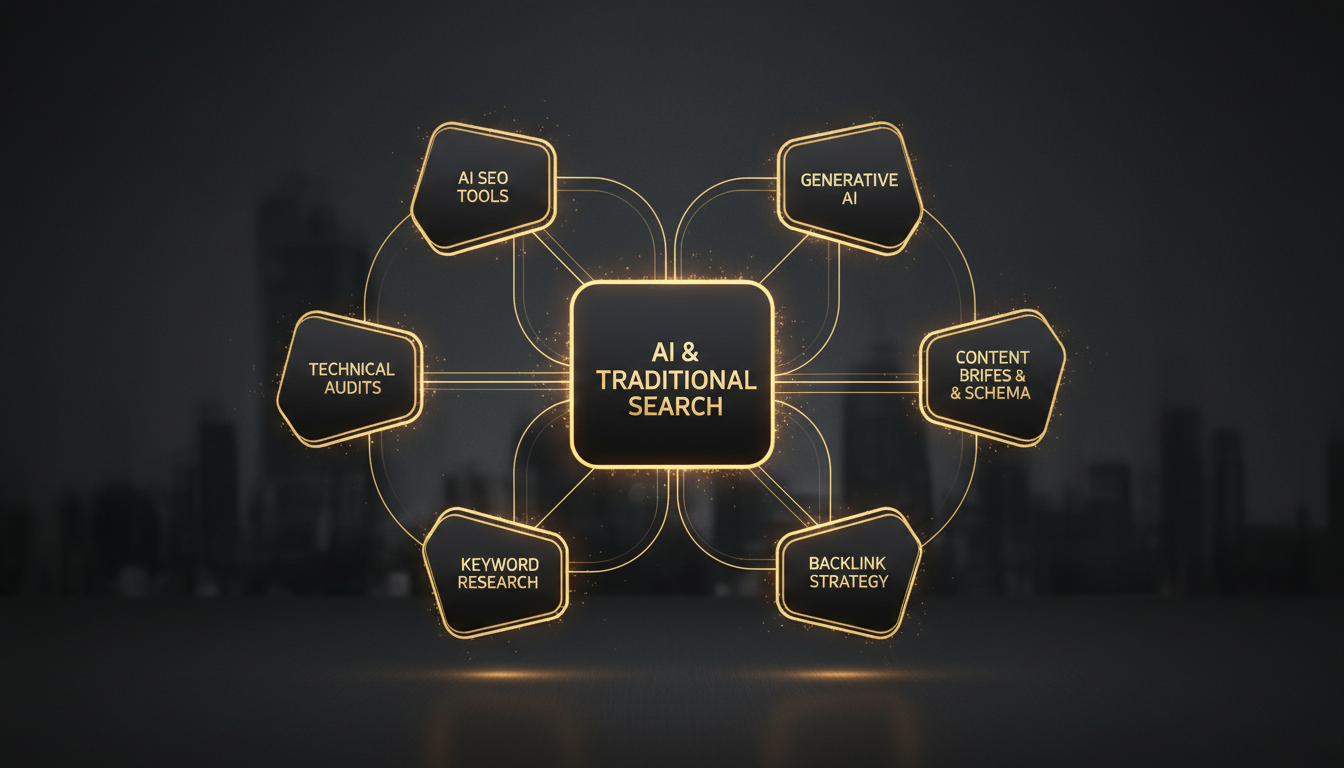
Building a topical authority map is one of the highest-leverage moves an SEO team can make right now — not just for Google rankings, but for earning citations in AI Overviews, ChatGPT, and Perplexity. If your site lacks a deliberate topical authority map, you are leaving both organic traffic and AI-generated referrals on the table.
Quick answer: A topical authority map is a strategic document that organizes your entire domain's content into pillar topics, supporting cluster pages, and the internal linking paths that connect them. It signals deep subject-matter expertise to Google's semantic search algorithms and to AI retrieval systems that prefer to cite comprehensive, interconnected sources. To build one: identify your core pillar topics, map every meaningful subtopic and entity beneath each pillar, audit existing content for gaps, assign cluster pages to fill those gaps, and wire everything together with a deliberate internal linking architecture. Done correctly, a topical authority map improves rankings across an entire topic area simultaneously and increases the probability that AI answer engines select your pages as source material.
Why Topical Authority Matters More Than Ever
Google's shift toward entity-based SEO and semantic search has changed what "ranking" actually requires. A single well-optimized page used to be enough. Today, Google evaluates whether your domain demonstrates comprehensive knowledge of a subject — not just whether one page has the right keywords.
AI answer engines amplify this dynamic further. Systems generating Google AI Overviews, ChatGPT responses, and Perplexity answers are trained to prefer sources that cover a topic exhaustively and consistently. A site with one strong article on a subject is less likely to be cited than a site with a pillar page, eight to fifteen supporting cluster pages, and clear entity relationships between them.
This is the core promise of a topical authority map: it transforms scattered content into a coherent knowledge structure that both algorithms and AI models can recognize as authoritative.
What a Topical Authority Map Actually Contains
Before building one, it helps to understand what the deliverable looks like. A topical authority map is not a content calendar or a keyword spreadsheet. It is a structured plan with four layers:
- Pillar topics — the broad subjects your domain claims expertise in
- Cluster pages — the specific subtopics, questions, and entities that support each pillar
- Internal linking paths — the deliberate connections between cluster pages and their pillar
- Coverage gaps — the missing content that weakens your authority signal
Pillar Topics vs. Content Clusters
A pillar page covers a broad topic comprehensively at a high level and links out to every cluster page beneath it. Each cluster page covers one specific subtopic in depth and links back to the pillar. This hub-and-spoke architecture is what Google's Knowledge Graph can traverse to understand your domain's topical scope.
A content cluster is a single hub-and-spoke grouping. A topical authority map is the full strategic document planning multiple clusters, their relationships, and their coverage gaps across the entire domain — a distinction that matters when you are managing a site at scale.
The Role of Entities and the Knowledge Graph
Entity-based SEO means Google does not just match keywords — it identifies the things your content is about: people, places, concepts, products, and their relationships. When your cluster pages consistently reference the same entities and link to each other, you reinforce those entity relationships in Google's Knowledge Graph. This is what makes topical authority durable: it is built on semantic relationships, not keyword density.
How to Build a Topical Authority Map: Step by Step
Step 1: Define Your Pillar Topics
Start with your business goals. What subjects must your domain own to drive qualified traffic and conversions? For an AI SEO platform, pillar topics might include generative engine optimization, technical SEO auditing, content strategy, and keyword research.
Each pillar topic should be:
- Broad enough to support 8–20 cluster pages
- Directly tied to a product, service, or audience need
- Defensible given your domain's existing authority
Avoid selecting pillar topics where established competitors have years of comprehensive coverage and you have nothing. Use AI competitor analysis and content gap tools to identify where rivals are thin and where you can realistically compete.
Step 2: Map Every Subtopic, Question, and Entity
For each pillar, brainstorm every meaningful subtopic a user might search. Include:
- Definitional questions ("What is…")
- How-to questions ("How to…")
- Comparison questions ("X vs. Y")
- Entity-specific deep dives (tools, techniques, named concepts)
AI keyword research is particularly effective here because it surfaces semantic variations and related entities that traditional keyword tools miss. You are not just looking for search volume — you are mapping the full conceptual territory of a subject.
Step 3: Audit Existing Content Against the Map
Overlay your existing content on the map. For each cluster page slot, you will find one of three situations:
| Status | Description | Action |
|---|---|---|
| Covered well | Existing page ranks and covers the subtopic thoroughly | Add to map, optimize internal links |
| Covered weakly | Existing page exists but is thin or off-target | Rewrite using a structured AI content brief |
| Gap | No page exists for this subtopic | Create new cluster page |
Prioritizing gaps that sit in high-intent subtopics — questions users ask just before making a decision — delivers the fastest measurable return.
Step 4: Build the Internal Linking Architecture
Internal links are the mechanism that communicates your topical map to crawlers and AI systems. Every cluster page should link back to its pillar. The pillar should link out to every cluster. Cluster pages covering related subtopics should cross-link where the connection is genuinely useful to readers.
Anchor text matters. Descriptive, keyword-relevant anchor text reinforces the entity relationships you are trying to establish. Generic anchors like "click here" waste the signal. For a detailed treatment of this, see the guide on internal linking as an AI SEO signal.
Step 5: Optimize for Generative Engine Optimization (GEO)
Building a topical authority map for AI retrieval requires one additional layer beyond traditional SEO. AI answer engines look for:
- Concise, self-contained definitions early in the page
- Direct answers to specific questions (not buried in prose)
- Consistent entity labeling across the cluster
- Schema markup that makes relationships machine-readable
Our complete guide to Generative Engine Optimization covers the full GEO methodology, but the topical authority map is the foundation it sits on. Without comprehensive cluster coverage, even perfectly formatted pages struggle to earn AI citations because the system cannot verify your domain's authority on the subject.
What Matters Most: Evaluation Framework
When assessing whether a topical authority map is working, prioritize these signals in order:
- Cluster keyword rankings — Are pages across the cluster rising together, not just the pillar?
- AI Overview appearances — Is your domain being cited in Google AI Overviews for target topics?
- AI citation frequency — Are ChatGPT and Perplexity referencing your cluster pages?
- Internal link equity flow — Is crawl data showing efficient link distribution across the cluster?
- Entity impressions in Search Console — Are branded and entity-based queries increasing?
The Google helpful content guidance and the Google SEO Starter Guide both reinforce that comprehensive, people-first content organized around genuine expertise is the durable path to visibility — a principle that maps directly onto the topical authority approach.
Topical Authority Map Checklist
Use this before publishing your map:
- Pillar topics are tied to specific business goals and audience needs
- Each pillar has 8–20 identified cluster page slots
- Every cluster slot is assigned a primary keyword and target entity
- Existing content has been audited against the map
- Content gaps are prioritized by search intent and conversion proximity
- Every cluster page links back to its pillar
- The pillar page links out to every cluster
- Anchor text is descriptive and entity-relevant
- Schema markup is planned for pillar and key cluster pages
- A measurement plan is in place for rankings, AI citations, and crawl efficiency
Frequently Asked Questions
What is a topical authority map in SEO?
A topical authority map is a structured plan that organizes your website's content into pillar topics and supporting cluster pages, signaling deep expertise on a subject to both Google's algorithms and AI answer engines.
How does topical authority help you get cited by AI search engines?
AI systems like ChatGPT and Perplexity prefer to cite sources that comprehensively cover a topic. A well-built topical authority map ensures you have interconnected, expert-level content on every subtopic, making your site a reliable reference AI models can quote.
How many cluster pages do you need to build topical authority?
There is no fixed number, but covering every meaningful subtopic, question, and entity within a pillar topic — typically 8 to 20 cluster pages per pillar — is enough to signal comprehensive expertise to Google and AI retrieval systems.
What is the difference between a content cluster and a topical authority map?
A content cluster is a single pillar-and-spoke grouping around one topic. A topical authority map is the broader strategic document that plans multiple clusters, their relationships, internal linking paths, and coverage gaps across an entire domain.
How do you measure topical authority improvements over time?
Track organic ranking improvements across cluster keywords, monitor AI Overview and AI citation appearances for your target topics, measure internal link equity flow with a crawl tool, and watch for increases in branded and entity-based search impressions in Google Search Console.
Your Next Step
The most common reason topical authority maps fail is that they stay in a spreadsheet and never get executed systematically. Start with one pillar topic — ideally the one closest to your core product or service — and map every cluster page slot before writing a single word. Audit what you already have, identify the three to five highest-priority gaps, and build those pages first with structured content briefs that target both traditional search and AI retrieval signals. That single pillar, executed completely, will demonstrate the compounding effect of topical authority faster than a partially built map across ten topics.