How to Build a Topical Authority Map for SEO (and Why AI Search Rewards It)
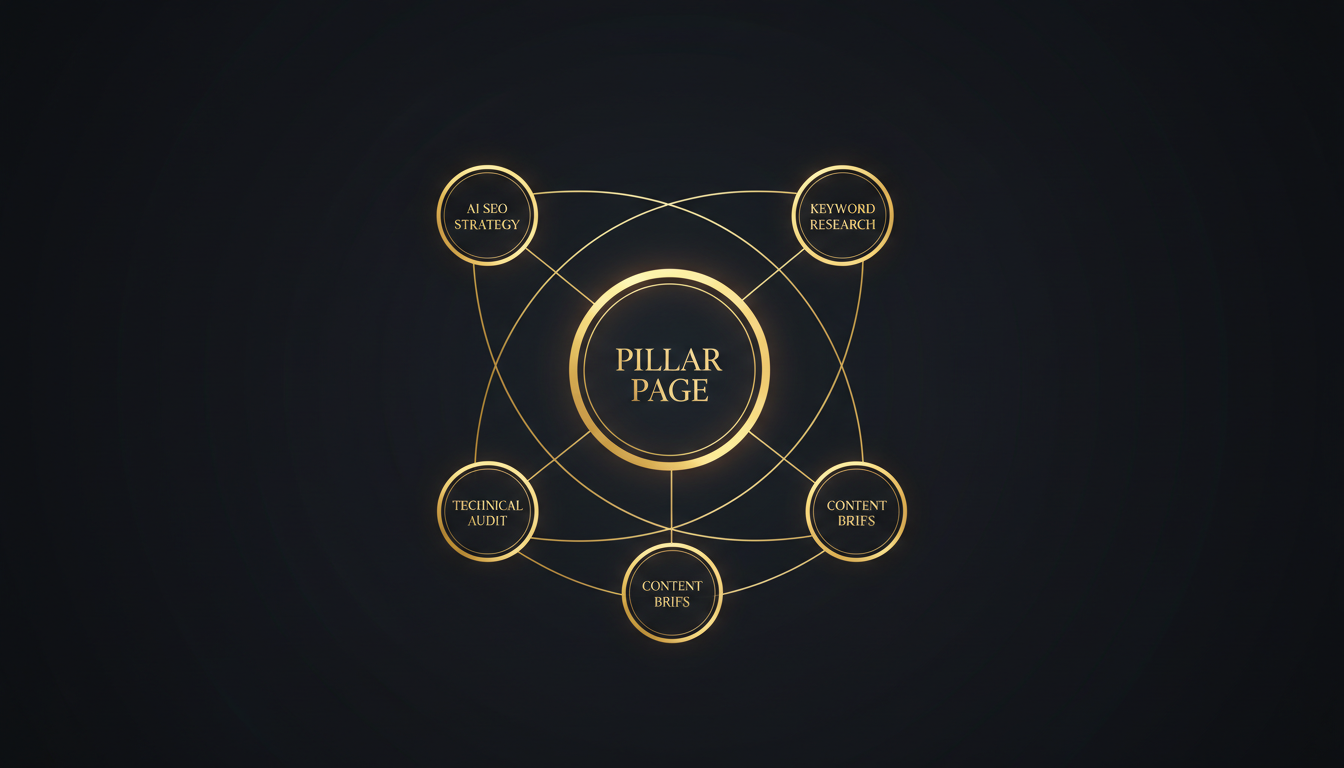
Building a topical authority map for SEO is one of the highest-leverage moves you can make right now — not just for traditional rankings, but for visibility in AI-generated answers from Google AI Overviews, ChatGPT, and Perplexity. As semantic search replaces keyword-matching logic and generative engines scan for trustworthy sources to cite, a well-structured topical authority map signals that your site owns a subject area, not just a handful of pages.
Quick answer: A topical authority map is a structured content plan that identifies a central pillar page and all the supporting cluster articles needed to comprehensively cover a subject. You build one by auditing existing content, mapping user questions to subtopics, assigning each subtopic a cluster page, and connecting everything with deliberate internal links. The result is a site architecture that tells search engines — and AI retrieval systems — that you are the authoritative reference on a topic, not just a participant. Depth, relevance, and consistent internal linking matter more than raw page count. Five to ten well-written cluster pages supporting one strong pillar page is a practical starting point for most niches.
What Is Topical Authority and Why Does It Matter Now?
Topical authority is the degree to which a website is recognized as a comprehensive, trustworthy source on a specific subject. Google's algorithms have moved well beyond matching exact keywords; they evaluate whether a site covers a topic in full, from foundational definitions to advanced subtopics, edge cases, and user questions at every stage of intent.
This shift is driven by semantic search — the ability of search engines to understand meaning, context, and entity relationships rather than just string-matching. When your content covers a topic's full semantic landscape, you rank for more queries with less individual optimization effort per page.
Why AI Search Engines Amplify This Signal
Generative Engine Optimization (GEO) extends the same logic into AI-driven retrieval. When ChatGPT, Perplexity, or Google AI Overviews generate an answer, they pull from sources that demonstrate consistent, deep expertise. A site with one strong article on a topic might get cited once. A site with a complete topical authority map — pillar page, cluster articles, FAQ content, and tight internal links — becomes the source an AI model returns to repeatedly because it reliably answers related questions.
For a deeper look at how AI answer engines select sources, the generative engine optimization complete guide covers the retrieval mechanics in detail.
How to Build a Topical Authority Map: Step by Step
Step 1: Define Your Topic Domain and Business Goal
Start with strategy, not content. Identify the core topic your business needs to own. For an SEO platform serving agencies, that might be "AI SEO for agencies." For a local law firm, it might be "personal injury law in [city]." The topic domain should be specific enough to be winnable but broad enough to support ten or more distinct subtopics.
Ask: what is the business outcome if we rank authoritatively here? Organic leads, demo requests, newsletter signups? Define the measurable goal before you write a single word.
Step 2: Conduct Semantic Keyword Research
Traditional keyword research finds high-volume terms. Semantic keyword research maps the full universe of questions, subtopics, and entity relationships users explore within your topic domain. You are looking for:
- Informational queries (what is, how does, why does)
- Navigational and comparison queries (X vs Y, best tools for Z)
- Transactional and intent-driven queries (how to choose, checklist for)
- Long-tail voice-search style questions
AI keyword research for high-intent topics competitors miss explains how to surface the subtopics your competitors have overlooked — which is exactly where authority gaps live.
Step 3: Audit Existing Content and Identify Gaps
Before creating new pages, map what you already have. List every existing article, landing page, and guide. Then compare that inventory against the full semantic keyword map from Step 2.
The gap between what you cover and what users search for is your content gap — and closing it is the core work of building topical authority. AI competitor analysis for SEO content gaps walks through a systematic method for identifying which subtopics competitors rank for that you do not yet address.
Step 4: Design the Pillar Page and Cluster Architecture
A pillar page is a comprehensive, long-form resource that covers the core topic at a high level and links out to each cluster article. Cluster articles go deep on individual subtopics and link back to the pillar. This bidirectional linking structure is what creates the topical signal.
| Element | Purpose | Typical Length |
|---|---|---|
| Pillar page | Covers the full topic, links to all clusters | 2,500–5,000+ words |
| Cluster article | Deep-dives one subtopic, links back to pillar | 1,000–2,500 words |
| FAQ content | Answers specific user questions, supports AI citation | 300–800 words per FAQ set |
| Supporting glossary entries | Defines entities, builds semantic context | 150–400 words each |
Step 5: Build and Optimize Internal Links
Internal linking is the connective tissue of your topical authority map. Every cluster article should link back to the pillar page using descriptive, keyword-relevant anchor text. The pillar page should link out to every cluster article. Related cluster articles should cross-link where the topics genuinely overlap.
This structure does three things: it passes relevance signals between pages, it guides crawlers through your topic architecture efficiently, and it signals to AI retrieval systems that your content is a coherent, interconnected knowledge base rather than isolated pages.
Internal linking as an AI SEO signal covers anchor text strategy, crawl efficiency, and how AI systems interpret link structure — worth reading before you finalize your map.
Step 6: Write Content That AI Systems Can Quote
Each page in your topical authority map should include at least one "quotable passage" — a concise, self-contained answer to the page's primary question. This is the passage an AI Overview or ChatGPT response is most likely to surface. Write it in the first 250 words, keep it under 150 words, and make it specific enough to stand alone without surrounding context.
Following Google helpful content guidance is the baseline here: content must be written for people first, demonstrate genuine expertise, and provide value beyond what a user could find by scanning a SERP. The Google SEO Starter Guide also provides foundational technical requirements that every page in your map should meet.
For the content brief workflow that makes this scalable, how to build AI-powered content briefs that rank provides a repeatable process.
What Matters Most When Evaluating Your Topical Authority Map
Use this checklist before you publish or audit your map:
- One clearly defined pillar page per topic domain
- At least five cluster articles, each covering a distinct subtopic or user question
- Every cluster article links back to the pillar with descriptive anchor text
- The pillar page links out to every cluster article
- No two cluster articles target the same primary keyword (cannibalization check)
- Each page includes a concise, quotable answer in the first 250 words
- FAQ sections address voice-search and conversational queries
- Schema markup (Article, FAQPage, BreadcrumbList) is applied where relevant
- Content gaps identified and assigned to future cluster articles
- Internal link audit confirms crawlers can reach every page within three clicks from the pillar
Topical Authority Maps and Google AI Overviews
Google AI Overviews pull from pages that demonstrate comprehensive coverage of a query's topic, not just the page that best matches the query keyword. A site with a complete topical authority map is structurally more likely to appear in AI Overviews because multiple pages in the cluster can each be cited for different aspects of a generated answer.
This is a compounding advantage: as your cluster grows, your probability of appearing in AI-generated answers grows with it — across a wider range of queries than any single page could capture alone.
Frequently Asked Questions
What is a topical authority map in SEO?
A topical authority map is a structured plan that organizes all the content a site needs to comprehensively cover a subject area. It identifies a central pillar page and the supporting cluster articles that link back to it, signaling to search engines that the site is an authoritative source on that topic.
Why do AI search engines like ChatGPT and Perplexity reward topical authority?
AI search engines retrieve and cite sources that demonstrate deep, consistent expertise across a topic. When a site covers a subject comprehensively with well-linked cluster content, AI models recognize it as a trustworthy reference and are more likely to quote or surface it in generated answers.
How many cluster pages do I need to build topical authority?
There is no fixed number, but a practical starting point is one pillar page supported by at least five to ten cluster articles that each address a distinct subtopic or user question. Depth and relevance matter more than volume—thin cluster pages hurt more than they help.
How does internal linking connect to topical authority?
Internal links pass relevance signals between cluster pages and the pillar page, reinforcing the topical relationship for both crawlers and AI retrieval systems. A consistent internal linking structure ensures every cluster article strengthens the authority of the central pillar.
How do I find content gaps in my topical authority map?
Compare your existing content against the full set of questions and subtopics users search for within your niche. Tools that analyze competitor content and SERP features can surface subtopics you have not yet covered, revealing the gaps that, once filled, complete your authority map.
Sources and Further Reading
Your practical next step: pull your existing content inventory into a spreadsheet, map each page to a topic domain, and identify which domains have fewer than five supporting cluster articles. Those are your authority gaps — and closing the most commercially important one first is the highest-ROI move you can make in your content calendar right now.
← All posts